Open data is one of the key elements of the modern information society, an integral part of effective governance, and a security tool. It supports economic development, attracts investment, enables the creation of innovative services that can make citizens’ lives more comfortable, and advances such important public goals as accountability and transparency. That is why new documents regulating the open data sphere in the EU appear almost every year and confirm its significance—and why the development of open data in Ukraine should be a priority for both central and local authorities.
In the report published by the European Commission on November 4, 2025, it is emphasized that Ukraine demonstrates notable progress in the use of open data, maintaining more than 80,000 datasets on its national open data portal, and that citizens’ right of access to public information is well regulated and consistently applied. However, the report also notes that access to certain public information remains restricted due to martial law, and that alignment with EU legislation, such as Directive (EU) 2019/1024 on open data and Regulation (EU) 2022/868 (the Data Governance Act), is partial and requires further legislative amendments.
To better understand what lies behind the figure of “80,000 datasets” in the part concerning central executive authorities, the Better Regulation Delivery Office (BRDO) launched an interactive dashboard in 2025. According to its developers, “this tool is about specifics: which data are already available, which are regularly updated, and which are not.” In turn, by including an “Open Data” block in the European City Index, the Transparent Cities program for the first time carried out a comprehensive analysis of what is happening in the open data field at the local level.
The methodology of the European Cities Index provides for a shift from one-off annual measurements to continuous monitoring. Analysts will record changes in transparency and accountability of city councils several times a year. That will be a step-by-step research with thematic blocs — openness of city councils, e-services, open data, use of budget funds, prevention of corruption, and so on. Each step will be supported by a separate methodology, with simultaneous announcement of results.
In the open data block, the emphasis was placed on the requirements of the Ukraine Facility Plan, first and foremost the reforms listed in the sections “Decentralization and Regional Policy,” “Human Capital,” “Transport,” “Green Transition and Environmental Protection,” “Energy Sector,” and “Business Environment.” The provisions of Directive (EU) 2019/1024 on open data and Regulation (EU) 2024/903 (the Interoperable Europe Act) were also taken into account.
Information on city councils’ performance against open data-related indicators was collected in December 2025.
The pilot sample included city councils of ten regional capitals (Dnipro, Zaporizhzhia, Kropyvnytskyi, Lutsk, Lviv, Odesa, Poltava, Kharkiv, Khmelnytskyi, and Chernihiv), as well as the city of Kyiv. The selected cities represent different levels of transparency across all macro-regions of Ukraine, different wartime circumstances (rear cities; cities included in the List of Territories of Potential Hostilities), and different data publication contexts (cities with and without their own open data portals).
The level of development of the open data ecosystem was assessed against 40 criteria. The final score was calculated by summing all points awarded to a city across these indicators. The maximum possible score a city could receive was 100 points.
The analysts checked:
- whether the official city council website has a dedicated open data section;
- whether that section contains links to key documents defining the city council’s open data policy;
- whether it provides consolidated information on e-services created on the basis of local self-government open data;
- whether the city council publishes “EU integration” datasets on the Unified State Open Data Web Portal (data.gov.ua);
- whether the principles of timeliness and interoperability are observed when publishing datasets.
Under Cabinet of Ministers Resolution No. 835, local self-government bodies must either upload dataset information or publish an application programming interface (API) to provide access to dataset information on the Unified State Open Data Web Portal. This concerns 70+ mandatory datasets. These do not include high-value datasets (the concept of such datasets was introduced by Directive (EU) 2019/1024). Therefore, the “EU integration” group included 30 datasets which, in the view of analysts from the Transparent Cities program, support implementation of the Ukraine Facility Plan:
- lists of legal regulations indicating the date of entry into force, the timeline for baseline, repeated, and periodic monitoring of their effectiveness, and information on the source of publication;
- the action plan for drafting legal regulations, indicating the types and titles of draft regulations, the goals of their adoption, drafting timelines, the names of bodies and units responsible for drafting, the date of submission for consideration by the regulatory authority, and a link to the source of publication;
- a list of approved construction titles for new construction, reconstruction, restoration, major repair, as well as routine repair and landscaping;
- a list of investment agreements, annexes, supplementary agreements, and other related materials, including terms and links to published online resources;
- information on vehicles serving passenger bus, trolleybus, and tram routes (brand, model, registration number, passenger capacity);
- data on the location of city electric and road transport stops;
- information on medicines/pharmaceuticals purchased for budget funds, information on the distribution of such medicines between health care institutions and their residues in each of them;
- roll-call results of voting of local council members at plenary sessions of the local self-government body;
- data on local council members, including contact information and reception schedules;
- data on green spaces subject to removal under issued green space inspection reports;
- data on building accessibility for persons with disabilities and other people with limited mobility;
- data on incoming calls/appeals to telephone hotlines, emergency dispatch services, call centers, etc.;
- data on e-petitions, including signatories and review outcomes;
- parking data, including locations of parking sites, operators, equipment, and operating arrangements;
- data on administrative services provided;
- data on medical equipment of municipal healthcare institutions;
- data on waiting lists for children in preschool education institutions;
- service areas of municipal general secondary education institutions;
- data on registration of citizens needing improved housing conditions (housing registry);
- data on utility consumption (electricity, heat energy, natural gas, solid fuel, liquid fuel, cold and hot water, indicating the share of renewable energy sources) by municipal enterprises, institutions, and organizations;
- real-time data on the location of city electric and passenger road transport, including short-term traffic changes and real-time arrival times at stops;
- a list of carriers providing city electric and road passenger transport services, including routes;
- timetables of city electric and road transport;
- data on repair of local roads;
- data on utility tariffs approved by the local self-government body;
- data on the location of municipal containers (by category), container sites, and collection points for hazardous waste and recyclables;
- data on the location of municipal waste management facilities, their area, and incoming volumes;
- data on the location of civil protection shelters;
- data on the location of electric vehicle charging stations;
- data on the operational characteristics of buildings of municipal enterprises, institutions (facilities), and organizations where energy management systems have been implemented.
This list does not include “urban planning” datasets (address register; urban cadastre data, including geospatial data; regional spatial planning schemes, district spatial planning schemes, master plans of settlements, zoning plans, detailed territory plans, etc.), because the state’s position on disclosure of these data remains unresolved even in the fourth year of the full-scale invasion. On the one hand, after the update to Cabinet of Ministers Resolution No. 835 in September 2025, these datasets remained among those mandatory for publication by local self-government bodies. On the other hand, in webinars for local authorities dedicated to entering data into the Urban Cadastre at the national level, responsible officials from the State Enterprise Administrator of the Urban Cadastre at the National Level emphasized a strict hierarchy of access to textual and graphic materials of urban planning documentation during martial law (see the video recording of December 4, 2025). Therefore, the experts decided not to include “urban planning” datasets in the list of “EU integration” datasets analyzed in this study.
The 40 assessment indicators were divided into two groups. The first concerned local self-government open data policy (10 indicators, 22 points), and the second concerned open data publication (30 indicators, 78 points).
Indicators related to policy were assessed using the “single entry point” principle. In other words, all information for the assessment was sought in a dedicated open data section of the official city council website. If no thematic section existed, the city received 0 points for all indicators in that group. Since both Kyiv City Council and the Kyiv City State Administration are information managers, for the capital the analysts looked for two thematic sections on the two respective websites.
Indicators related to open data publication were analyzed using the “single window” principle. This principle provides that “public authorities, regardless of the legal personality of structural units and separate structural units with legal entity status, must publish public information through the use of a single electronic account on the Unified State Open Data Web Portal.” Accordingly, the analysts searched for open datasets in electronic accounts on data.gov.ua named Dnipro City Council, Kropyvnytskyi City Council, Odesa City Council, and so on. For Kyiv, an exception was again made due to the complex structure of governance in the capital—the search was conducted in two accounts.
The methodology also stipulated that each “EU integration” dataset must correspond to only one dataset in the city council’s electronic account. If this condition was not met, the indicator associated with that dataset was scored at 0 points by the program’s experts.
Under Cabinet of Ministers of Ukraine Resolution No. 835, information managers must upload and regularly update datasets on the Unified State Open Data Web Portal, taking into account recommendations published by the Ministry of Digital Transformation. These recommendations formed the basis for assessing each of the 30 “EU integration” datasets. The analysts identified seven key components of analysis (sub-indicators) and examined each dataset against these components.
Sub-indicators for assessing each “EU integration” dataset and maximum scores for compliance
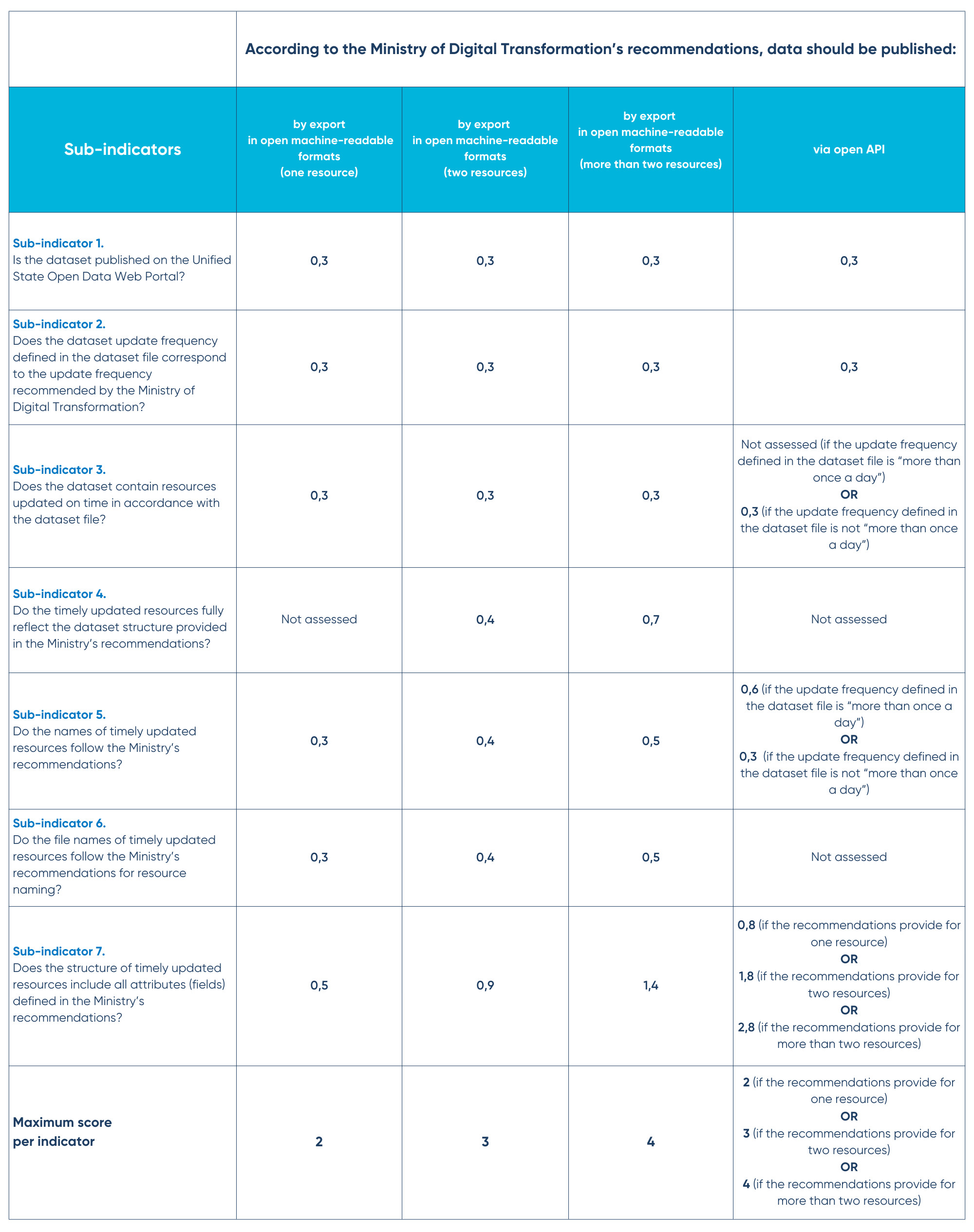
Sub-indicators 4–7 were assessed only for datasets where resources updated on time in accordance with the dataset file were identified. If the file specified the update frequency as “immediately after changes are made,” the presence of timely updated resources was determined based on the Ministry’s recommendations. For example, for the Lviv City Council dataset “Data on local council members,” timely updates were checked against the Ministry’s recommendation to update this dataset annually. If a dataset did not contain timely updated resources, sub-indicators 4–7 were scored 0.
When assessing sub-indicator 7, the analysts used table templates available on each page of the Ministry’s recommendations as reference models. The exception was the dataset “Real-time data on the location of urban electric and passenger road transport,” because the recommendations page itself (the vehiclePosition table structure) and the corresponding table template contain different lists of attributes (fields). Therefore, when assessing sub-indicator 7 for this dataset, only the presence of core attributes (id, lat, lon, speed, timestamp) was checked.
After assigning the relevant points, the analysts determined each dataset’s indicator score as the sum of the scores obtained across the seven sub-indicators.
Important note. During martial law in Ukraine, the Ministry of Digital Transformation temporarily removed from public access the datasets of information managers from Donetsk, Zaporizhzhia, Luhansk, Mykolaiv, Kharkiv, and Kherson regions. Since, before 2022, Zaporizhzhia and Kharkiv city councils had actively published datasets in their electronic accounts on data.gov.ua, it was decided to assign, as their scores for the respective indicators, the arithmetic mean of the indicator scores of the nine cities whose datasets had not been removed from public access.
This research is made possible with the support of the MATRA Programme of the Embassy of the Kingdom of the Netherlands in Ukraine, and with the financial support of Sweden within the framework of the program on institutional development of Transparency International Ukraine. Content reflects the views of the author(s) and does not necessarily correspond with the position of the Embassy of the Kingdom of the Netherlands in Ukraine or the Government of Sweden.