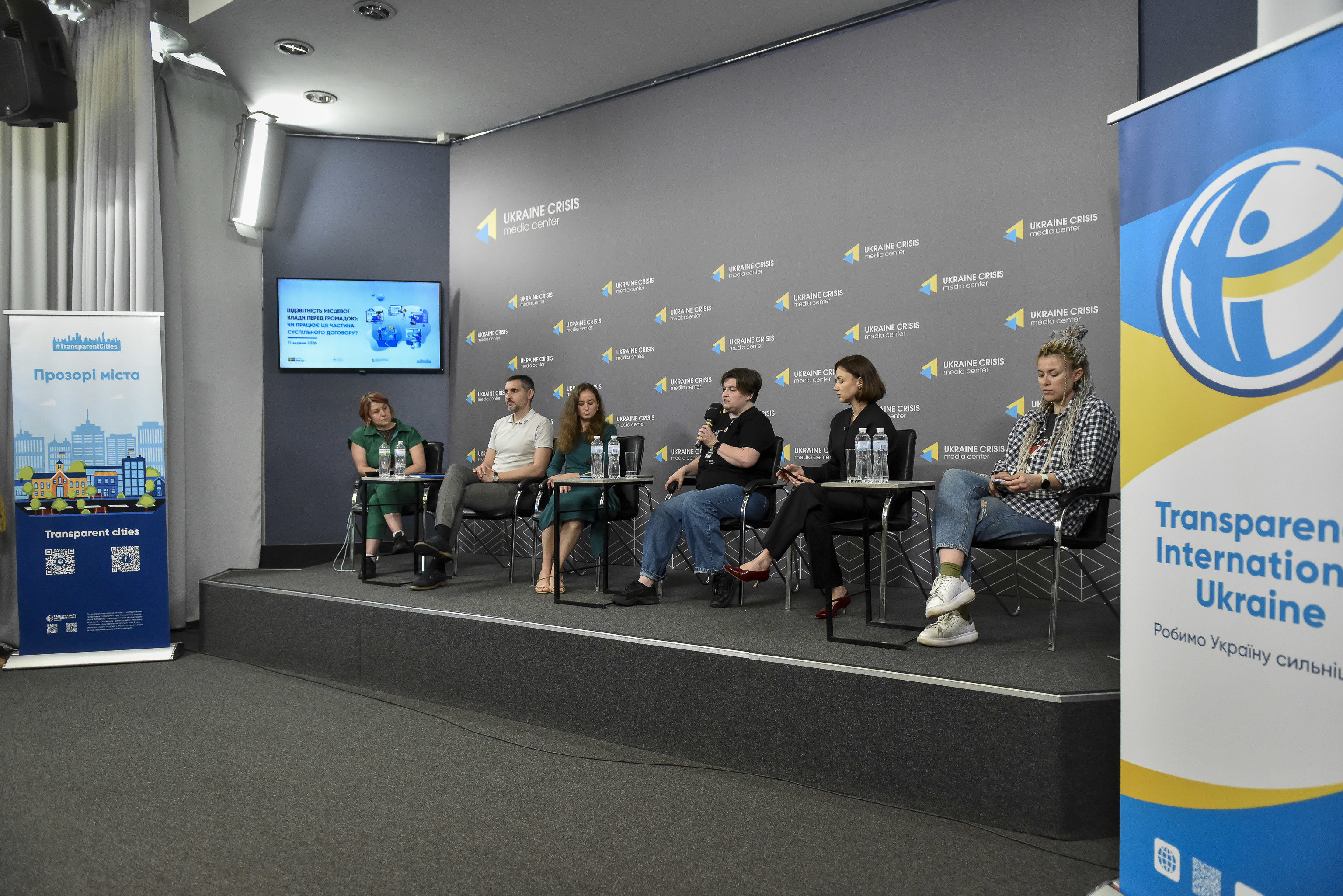
On June 11, local authorities, regional media, civil society organizations, and experts sat down together to settle one question: do city councils really report to their communities — and if so, why do so few people notice?
The conversation was convened by the TI Ukraine's Transparent Cities program, which, together with the Center for Content Analysis, carried out Ukraine's first media study of public reporting by local self-government bodies.
The conclusion is unambiguous: the reports exist, but the results of the authorities' work do not always reach the community, because cities draw on a range of communication elements and formats, mostly without any systematic approach.
Reporting information makes its way into regional media and social networks far less often than onto the city councils' own official channels. And when it does appear, it is usually written in bureaucratic language, with no adaptation for a general audience.
The reports delivered by the mayors of Dnipro and Lviv drew the greatest response. Both city leaders are public figures with large audiences, yet the reaction to their reports differed. In Lviv, restricted access to the event drew criticism on social media, whereas in Dnipro the reporting did not spark the same level of public debate.
Kharkiv, Odesa, and Kropyvnytskyi pointed to a different problem: there, engagement with residents was weaker, even though the documents often remained formally accessible.
Where reports did reach the press, mayors were quoted in three-quarters of all coverage — while on social media, officials' own words appeared far less often. On the whole, regional media frequently reproduced official communication, reprinting press releases and only rarely preparing analytical material of their own.
In wartime, local self-government bodies take on greater responsibility and make decisions that directly affect the life of their communities. That is precisely why residents need more openness about how those decisions are made and carried out.
Anastasiia Mazurok, Chief Operating Officer of TI Ukraine, stressed that in wartime — when elections are not held, and the social contract grows more complicated — public oversight becomes a lever of checks and balances. An information vacuum, in this context, is not merely a communication problem; it means decisions get made without enough data. When people don't know whether their city is preparing for the heating season, they make choices based on rumor rather than fact. “Accountability is not about weakness or formality. It is a resource that, used properly, strengthens everyone,” she emphasized.
According to Mazurok, the problem of accountability cannot be solved by the efforts of one side alone.
“Complex problems are not overcome by simple means. When we want to achieve meaningful change, it's important to find allies among different stakeholders and look for new solutions together. It is in cooperation like this that the greatest strength and synergy are born,” she noted.
The communication teams of local self-government bodies face numerous challenges and constraints, which makes an outside assessment of their work valuable — a way to see the results from a different perspective.
“Studies like this really are important; they give us a reason to reflect on what we can change and help us better assess the results of our work,” noted Kateryna Baranova, Head of the Department of Information Policy and Access to Public Information at the Kyiv City State Administration.
According to Baranova, beyond the question of resources, a further challenge is competing for attention with dubious Telegram channels and countering disinformation. So although a great deal of information about the city's work is published, it often gets lost in the general flow.
Yet the sheer number of messages is no guarantee that reporting information will be noticed and understood by residents. That is why the issue lies not only in the volume of communication but also in its format, language, and channels of distribution. Regional media have a distinct role to play here: they are the ones who can translate complex administrative information into language residents understand and create space for meaningful dialogue between the authorities and the community.
This point was emphasized by Nika Yehorova, editor-in-chief of Dnipro.media. “What really appeals to me is being able to write in plain human language — and to get an answer in plain human language in return. When both sides are open to dialogue, the media can translate reports into language the community understands, so that people know what is happening in their city,” she said.
Serhii Stukanov, Head of the Analytical Department at the Center for Content Analysis, explained the study's findings in part by the fact that officials often perceive accountability not as an opportunity for dialogue but as a potential risk.
“Every report is an assessment of an official's performance, and any assessment carries the possibility of criticism. That is exactly why not all authorities are eager to announce their reports in advance or interested in a broad discussion of the results,” he noted.
In his opinion, the particular value of such studies is that they create a shared analytical foundation for further change.
“There is now analytical material to build on — to draw conclusions from and to change. I hope this study becomes one more building block in developing dialogue between the authorities and the community,” Stukanov concluded.
The participants in the discussion linked a solution not only to political will and resources but also to a readiness to seek out new ways of reaching people. Uliana Kolodii, CEO of u.comms communications agency, stressed that today citizens' trust is increasingly formed outside official channels.
“If you genuinely want information to reach people, you have to move into other formats and channels of communication — to work with opinion leaders, volunteers, veterans, and other communities that people trust. If there is the will and the courage to hold an open dialogue, then even the most difficult communication tasks become far simpler,” she emphasized.
The experts did not merely document the current state of public reporting in Ukrainian cities; they also offered practical recommendations for improving communication between the authorities, the media, and communities. Transparent Cities prepared recommendations for all city councils, along with tailored road maps for each of the 11 cities studied. A full recording of the discussion is available on the program's YouTube channel and Facebook page.
Background
The study covered the period from December 2025 to March 2026 — the peak reporting season for local authorities. Analysts examined 11 cities: ten regional centers and Kyiv. For each, they monitored the official channels of the city council and the mayor, five leading regional online outlets, the local office of the Suspilne public broadcaster, and discussions on Facebook, Instagram, and TikTok. More on the results can be found in the presentation.