None of the large Ukrainian cities under review crossed the "performance threshold" in managing funds and resources. Municipalities maintain financial governability and publish core documents, but often shut residents out of decision-making. The highest score was 60 of 100 — and even the leaders failed to combine quality resource management with genuine engagement of community residents.
Transparency International Ukraine's Transparent Cities program has released the findings of a study that comprehensively assesses how ready municipalities are for European standards in public finance. Analysts examined two key dimensions: how effectively cities manage budget funds and property — and how openly they explain this to residents and engage them in decisions. Municipalities were assessed against 40 criteria: half covered the direct handling of resources (based on data from Open Budget, Prozorro, and Prozorro.Sale), the other half covered information availability and user-friendliness on city council websites.
The pilot sample included the city councils of 10 regional capitals (Dnipro, Zaporizhzhia, Kropyvnytskyi, Lutsk, Lviv, Odesa, Poltava, Kharkiv, Khmelnytskyi, Chernihiv) and Kyiv.
On average, cities met the requirements on budget transparency and effectiveness at just 44.4%. The highest score — 60 points — went to Dnipro, but even Dnipro fell short of a comprehensive approach to managing finances. Lutsk followed with 57 points, then Kyiv and Khmelnytskyi with 52. The lowest scores went to Chernihiv (21), Poltava (24), and Kharkiv (25).
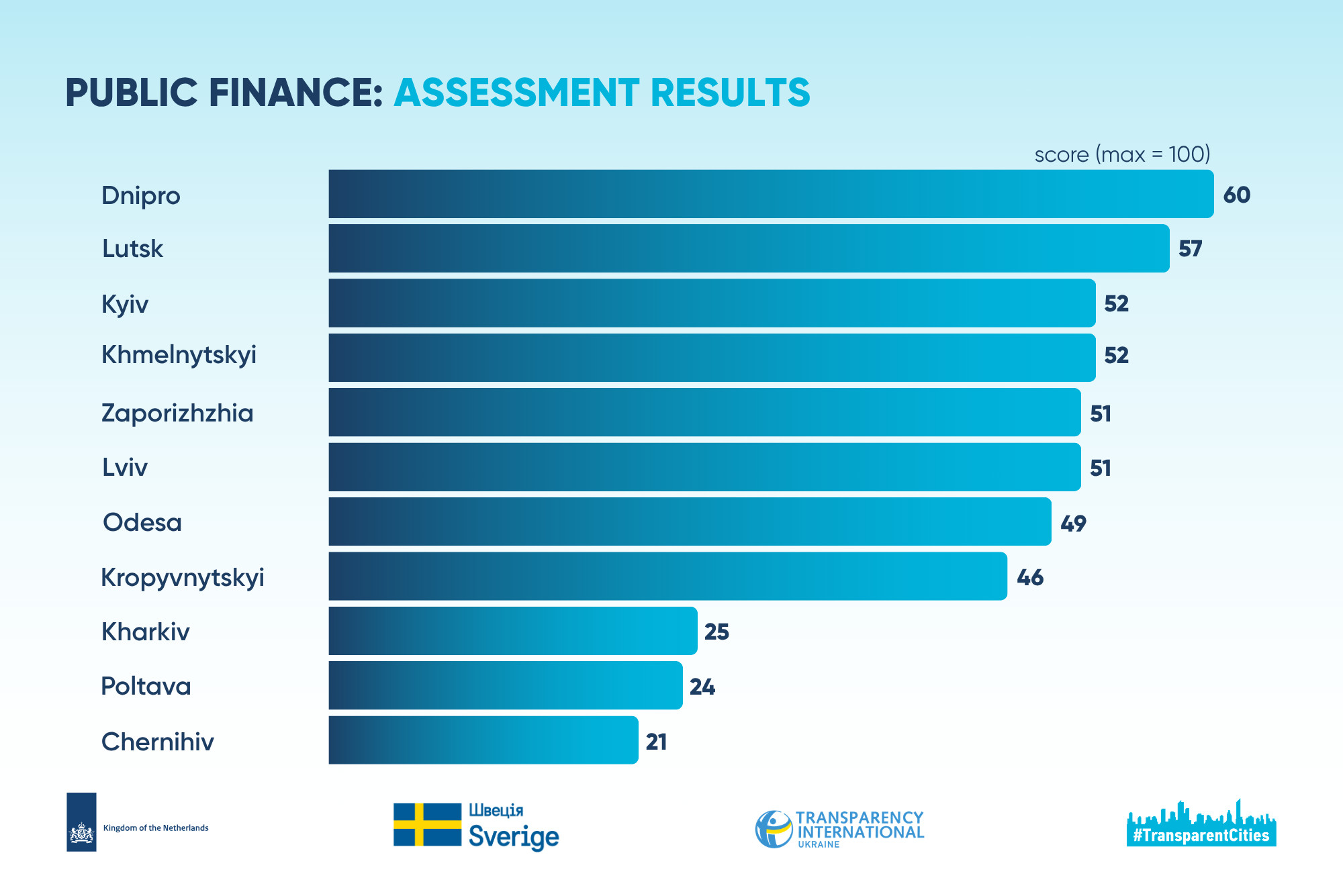
"Cities show individual strengths, but they cannot combine them into a system. Dnipro is an example of performance without sufficient openness — the city had accurate budget planning and worked actively with the Prozorro and Prozorro.Sale systems, but did not publish a number of important documents and did poorly on engaging residents in the budget process. Lutsk is the opposite: it set up information availability, but did worse on the effectiveness of managing finances and communal property. The State Audit Service captured this, by the way," noted Olesia Koval, Transparent Cities Program Manager.
On budget openness, cities averaged 43.3%. Lutsk and Khmelnytskyi each scored 30 of 46 possible points, while the lowest scores went to Poltava (2 points) and Chernihiv and Kharkiv (5 points each).
8 of 11 cities already provide a baseline level of budget openness, and most of them publish key documents: the decision on the 2026 budget (8 cities), lists of spending administrators, and quarterly reports (7 cities). Only three municipalities published the budget regulations, and only Kyiv, Odesa, and Khmelnytskyi published the current consolidated version of the budget. The quality of access to information remains uneven: Poltava has no budget section at all, while in Kharkiv and Chernihiv it is overloaded with dozens of pages, making navigation difficult even for informed users.
On the effectiveness of fund management, despite the war, Ukrainian cities maintain a basic level of financial capacity and demonstrate fairly high accuracy in budget planning: the average deviation of actual revenues from plan was just 3.08%. This means that technically, local budget management is stable and close to European standards.
All cities under review supplied contracting authority hierarchies for the BI Prozorro analytical resource and used Prozorro.Sale for municipal property leasing auctions. 9 of 11 municipalities also held small-scale privatization procedures on Prozorro.Sale and created a dedicated thematic section on public procurement.
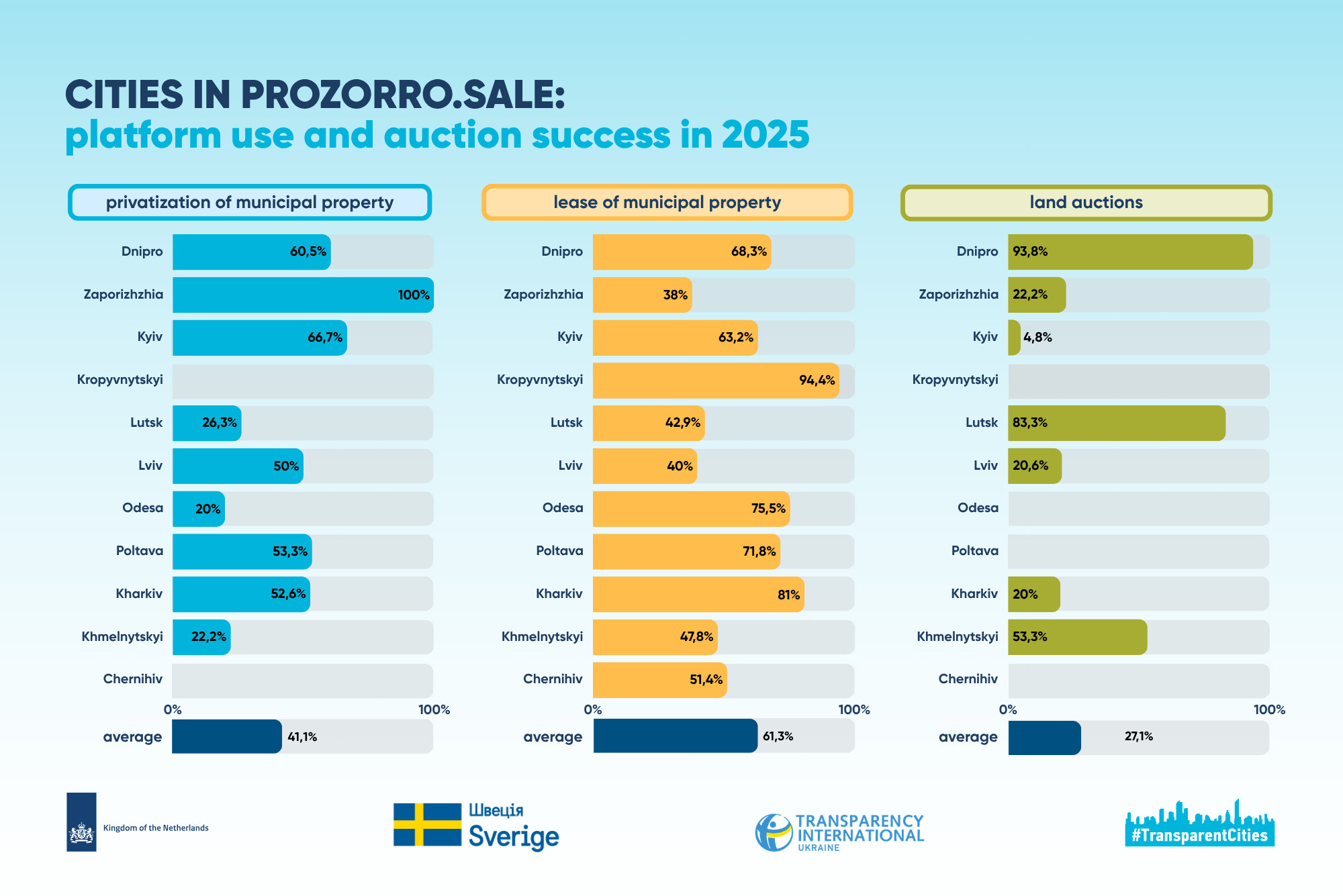
At the same time, the level of resident engagement in budget processes is a cause for concern. No city published, in a dedicated budget section, the list of public proposals to the draft 2026 budget. Minutes of public hearings on the draft budget and the results of consultations with business on procurement are missing in 10 of 11 cities under review. They also failed to deliver a budget surplus in 2025.
The budget sector needs to function as an integrated system, where effectiveness and transparency reinforce each other. This is not only about using the capabilities of state IT systems, but about shifting the approach: the public must not be an audience for reports, but a full participant in planning — with access to data and real influence over decisions. The point is not to avoid external scrutiny, but to use it, and to treat oversight not as a threat but as a tool for improvement.
The Transparent Cities program will prepare recommendations for each city council from the study, to serve as roadmaps for improving how they actually work with public finance.
For cities not included in the pilot study, program experts have prepared a form that will help them assess independently how effectively and transparently they manage their finances and highlight the weaknesses that need to be addressed.
This research is made possible with the support of the MATRA Programme of the Embassy of the Kingdom of the Netherlands in Ukraine, and with the financial support of Sweden within the framework of the program on institutional development of Transparency International Ukraine.
Content reflects the views of the author(s) and does not necessarily correspond with the position of the Embassy of the Kingdom of the Netherlands in Ukraine or the Government of Sweden.