In 2025, the Transparent Cities program launched a pilot study format to assess how ready Ukrainian cities are for EU integration. The criteria of the European City Index are aligned with key EU integration documents. Program experts have already examined how municipalities ensure openness on their websites, manage e-services, and work with open data. The fourth stage of the study analyzes public finance — a foundational component of EU integration readiness and effective local governance.
Ukrainian cities manage their budgets under unprecedented pressure: they simultaneously finance infrastructure recovery, support for IDPs, and social needs, sustain defense and security, while losing part of their revenues due to business relocation and a shrinking taxpayer base.
According to KSE, in 2025 the revenues of territorial communities exceeded UAH 554 billion (12% more than in 2024), but this growth is largely nominal and offsets inflation. The largest resources are traditionally concentrated in economically strong regions — Dnipropetrovsk, Lviv, Kyiv, Kharkiv, and Odesa — which together account for nearly half of all revenues.
Expenditures are growing faster than revenues (+14.7%), with about 82.5% going to current operating costs of the public sector, particularly payroll. The share of capital expenditures remains low (~17.5%), which limits opportunities for development.
As a result, most resources are spent on keeping the system running rather than on investment. This is why the efficiency and transparency with which these funds are managed directly affect the quality of basic services and the resilience and recovery capacity of communities.
For municipalities, then, it is important not only to improve the management of finances, municipal property, and resources, but also to publish budget information openly and regularly, create real opportunities for residents to take part in decision-making, and remain accountable for how funds are used. This builds trust among local audiences as well as business, donors, and international partners and organizations.
Research methodology
The “EU integration alignment” of this study, as in previous installments, is grounded in the provisions of the Ukraine Facility Plan and in the recommendations of the European Commission's Enlargement Reports for 2023–2025. In particular, in the 2025 Report the EC called for stronger budget transparency and medium-term budget planning as elements of more mature fiscal policy, and gave special attention to public procurement. These priorities are also reflected in the EU-aligned set of criteria for Ukraine across the three most important clusters: the local level is mentioned there only in the context of public procurement.
The “Public Finance” indicators also draw on international approaches to assessing budget transparency and effectiveness, in particular the OECD Budget Transparency Toolkit and the Public Expenditure and Financial Accountability (PEFA) framework. Program analysts maintain that an integral part of budget transparency is making information about local finances clear and accessible to a wide range of users. For this reason, the subindex also checked whether dedicated thematic sections exist and whether they meet the “single point of entry” principle.
In the “Public Finance” block, analysts examined two dimensions: how local authorities manage funds and resources, and how transparently they communicate this and provide access to the information. For a resident, transparency in the budget area means the ability to check whether their taxes are being used effectively, whether spending matches people's needs, and whether local authorities are abusing their powers. For partners and potential investors, openness in financial processes signals how efficiently and honestly a city will manage their resources. Transparent management of the community's budget and resources is the foundation for trust between authorities, residents, and international partners.
Indicators of planning quality, procurement, and lease and privatization auctions can be affected by external factors — from the relocation of businesses and taxpayers to damaged infrastructure. Despite these challenges, the program encourages communities to follow European budgeting rules. One example is keeping the deviation between actual and planned budget revenues or expenditures to a minimum. This is the European standard for assessing budget credibility — that is, the authorities' ability to stick to their own plans and allocate resources effectively.
The pilot sample included the city councils of 10 regional capitals (Dnipro, Zaporizhzhia, Kropyvnytskyi, Lutsk, Lviv, Odesa, Poltava, Kharkiv, Khmelnytskyi, Chernihiv) and the city of Kyiv.
Municipalities were assessed against 40 indicators, with a maximum score of 100 points. The assessment was carried out through automated analysis of data from the national Open Budget, Prozorro, and Prozorro.Sale systems (20 indicators) and through the conventional review of information availability on the official websites of local self-government bodies (also 20 indicators).
For 20 criteria related to the publication of important budget information, cities could earn up to 46 points. Here, analysts checked compliance with the “single point of entry” principle for two website sections: the local budget section (17 criteria) and the public procurement section (2 criteria). They reviewed the availability of key documents — the budget regulations, forecasts, decisions on the budgets for 2025 and 2026, quarterly reports, local debt management programs, and so on. Separately, they recorded how cities inform residents about their involvement in the budget process, and whether city councils submit data on the hierarchy of subordinate contracting authorities to the BI Prozorro analytical resource.
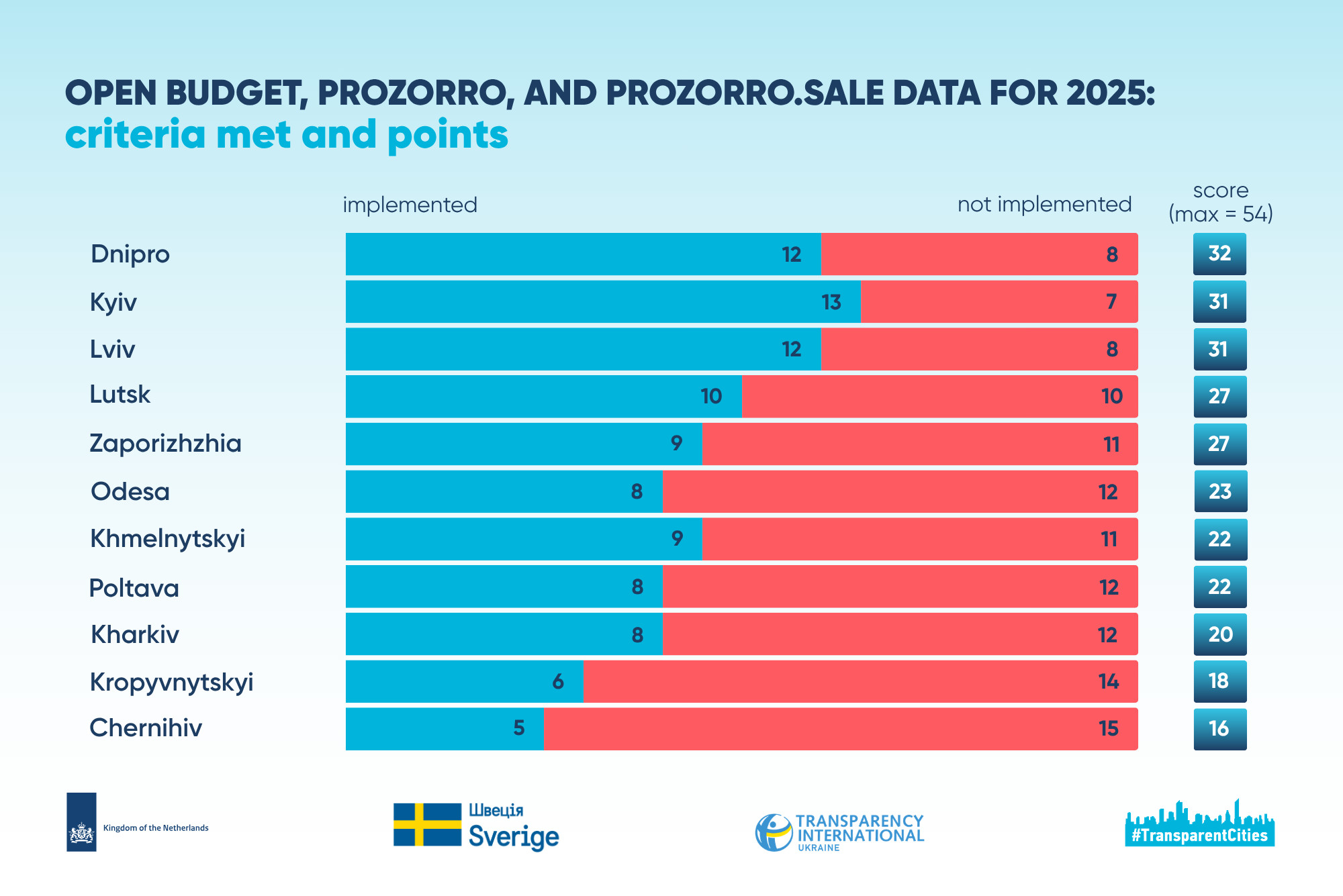
The automated part of the assessment covered 20 criteria with a maximum of 54 points. The data was retrieved through API endpoints from state information systems, ensuring accuracy. Specifically, 7 indicators based on data from the Open Budget public web portal assessed the quality of the budget process; 4 indicators analyzed how effectively municipalities work in the Prozorro system; and 9 more measured how productively communities use prozorro.sale to manage assets. On Prozorro and Prozorro.Sale, the data of all contracting authorities subordinate to the city council was reviewed. It is worth noting that the list of subordinate organizers covered in this study is broader than the contracting authority hierarchies that city councils have currently configured in the BI Prozorro analytics module. Thresholds for these indicators were set based on the average result across the full sample of 11 cities.
The assessment was conducted in March 2026.
Research results
On average, cities met the criteria of the “Public Finance” block at 44.4%. Compared to previous studies on openness and public engagement (53.5%) and e-services (49.8%), this result is somewhat lower, although it is better than the result for the “Open Data” block (23.1%), even though finance is an area of high public interest and maximum risk.
Dnipro had the highest score — 60 points. Lutsk followed with 57 points, then Kyiv and Khmelnytskyi with 52. The lowest scores went to Chernihiv (21 points), Poltava (24), and Kharkiv (25).
Overall, all cities posted modest results for an area of this importance.
Effective planning and effective use of Prozorro.Sale to manage community property helped Dnipro lead the sample. At the same time, analysts identified problems with the publication of key documents and with informing residents about their participation in the budget process — Dnipro's website did not feature the minutes of public hearings on the draft budget or the results of consultations with business.
A detailed review of the hearings held in Dnipro and of the city's documents revealed regulatory inconsistencies between the Community Charter, new legislative requirements, and the approved Procedure for Holding Public Hearings on the Draft Budget. Program representatives sent recommendations to the city council. In response, the mayor confirmed that an updated version of the Community Charter is in development.
Lutsk, in turn, populated its budget and procurement sections well — taking first place in this dimension together with Khmelnytskyi. Despite its strong scores for thematic section content, Lutsk earned far fewer points on planning effectiveness and management of municipal property, which is consistent with the conclusions of the State Audit Service of Ukraine, which identified significant financial violations.
Kyiv failed 11 of the 17 indicators related to the budget section, restricting residents' right of access to important information. The capital, however, met the largest number of criteria based on data from Open Budget, Prozorro, and Prozorro.Sale.
Chernihiv, Poltava, and Kharkiv did not provide structured budget sections on their official websites, which significantly affected their scores and rankings.
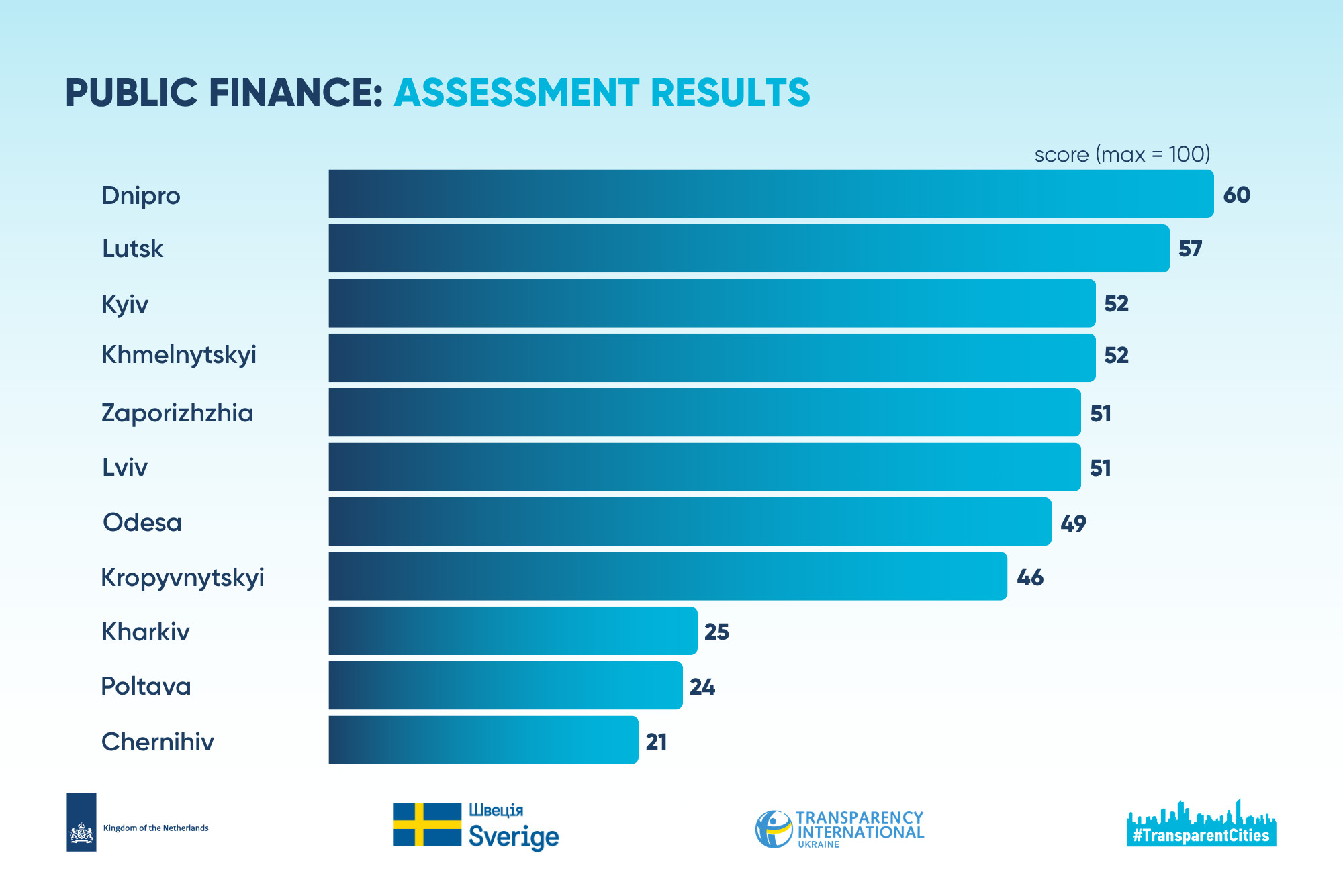
Cities performed best on the following criteria:
- Using Prozorro.Sale for municipal property leasing auctions and configuring the contracting authority hierarchy for BI Prozorro (all 11 cities)
- Holding small-scale privatization procedures through Prozorro.Sale and providing a dedicated section on public procurement on the website (9 cities each)
- Publishing the decision on the 2026 budget in the thematic section, using Prozorro.Sale for land auctions, executing general fund revenues within the sample's average, and creating a dedicated section on the local budget (8 cities each met these indicators).
Cities performed worst on:
- Publishing the list of public proposals to the draft budget and publishing reports on budget program passports on the Open Budget portal (no city met these criteria)
- Publishing minutes of public hearings on the draft budget and the results of consultations with business on procurement (10 cities each)
- Publishing the Local Debt Management Program for 2026, posting a link to the territorial community profile on the Open Budget portal or to the Spending portal next to the list of main spending administrators, and posting budget program passports on the Open Budget portal (9 cities each).
Availability of financial information
Cities met the 20 criteria for publishing key budget and procurement information at an average rate of 43.3%.
Lutsk and Khmelnytskyi did the best on accessibility, scoring 30 of 46 possible points each. The lowest scores went to Chernihiv and Kharkiv (5 points each) and Poltava, with only 2 points.
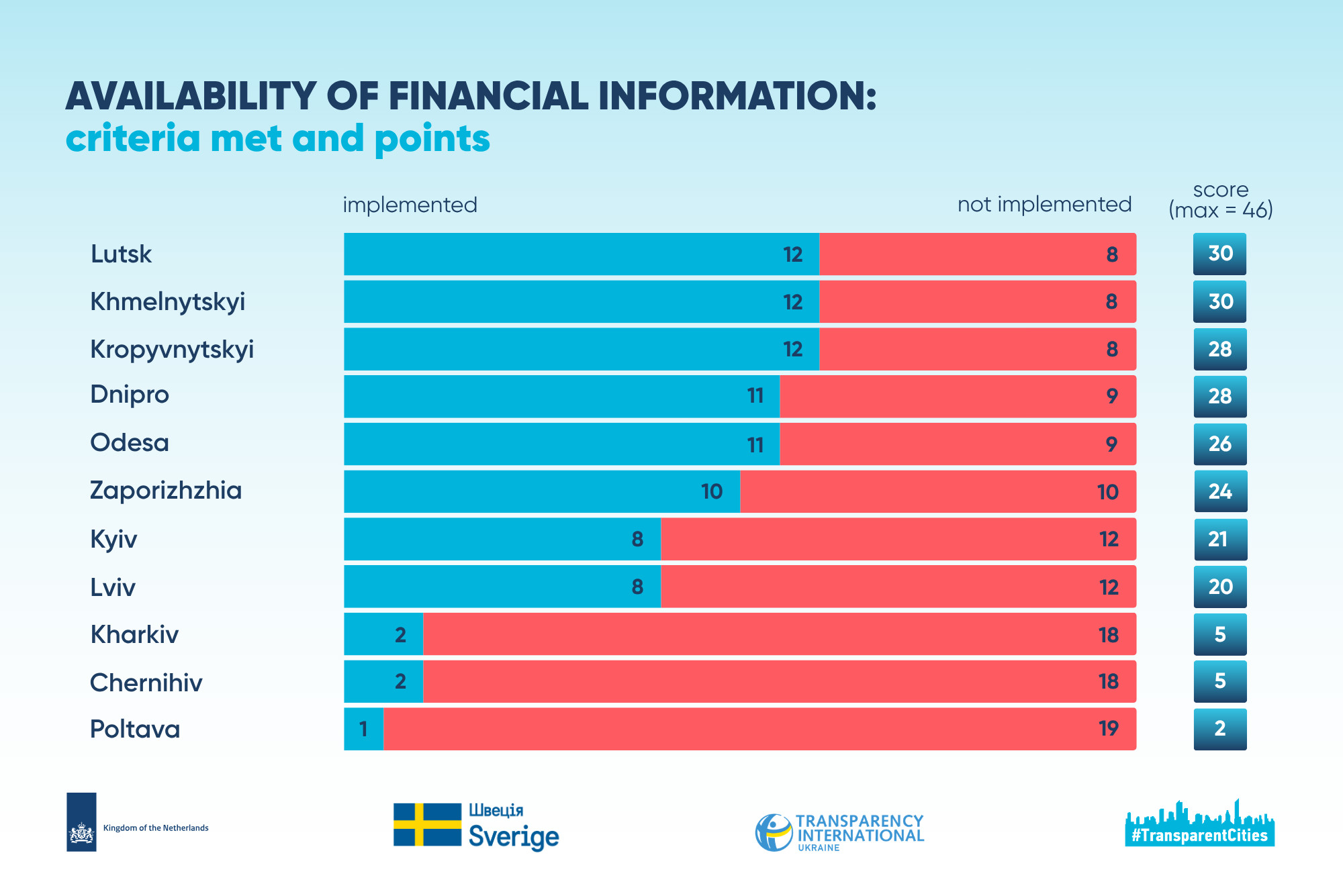
All available reference information on a given topic — for example, the community budget or public procurement — should be conveniently gathered in one place. Structuring information on local government communication channels around the “single point of entry” principle helps residents find the data they need easily. If decisions, minutes, and instructions are hard to track down even for analysts, ordinary citizens have even less chance of exercising their right of access.
8 of 11 cities created a proper budget section. The Poltava city council website has no budget section at all. In Kharkiv and Chernihiv, the relevant sections consist of numerous pages with lists of links to documents, which makes navigation very difficult for users. Kharkiv has 73 such pages. The absence or unstructured nature of the budget sections is what produced the low scores for these three cities — analysts did not check the other indicators related to section content for them.
The content of thematic sections on local budgets was assessed against 17 indicators. Cities handled document publication very differently. Only three municipalities published the budget regulations: Zaporizhzhia, Kropyvnytskyi, and Khmelnytskyi. The documents of these cities establish residents' right to take part in budget planning. A link to the decision on the 2026 budget was found in 8 of 11 cities — that is, in all of those that had created a separate budget section. At the same time, only Kyiv, Odesa, and Khmelnytskyi published the consolidated current version of the 2025 budget reflecting all the changes made during the year.
More than half of the cities (7 of 11) published lists of main spending administrators and reports on the execution of the territorial community budget for the three-, six-, and nine-month periods of 2025. Among the cities with a budget section, Khmelnytskyi did not post quarterly reports, and Lviv did not post the list of spending administrators.
Communicating the results of public engagement in the budget process turned out to be the most problematic area. Information on public hearings on the draft budget is scattered across various website pages and social media. The Euroindex methodology, by contrast, requires data to be published on the “single point of entry” principle — on a single page or in a single section where the user can easily find it. By that standard, only Khmelnytskyi posted hearing minutes in the proper place. The other 10 municipalities did not add minutes to their thematic section, although announcements of hearings were found in 5 cities.
No city published a full list of proposals received from residents during hearings or through other forms of engagement in its budget section. Municipalities offered different ways to engage: in Lviv, for example, residents were encouraged to send proposals by email, but the results of that collection, together with the proposals from the budget hearings, are not reflected in the thematic section. Publishing such lists, especially with a record of how proposals were considered, is critical. It demonstrates to residents that their engagement was not a formality, and lets them understand the authorities' reasoning: why some proposals were accepted and others were rejected.
Analysts also paid attention to whether links to state information portals were placed in the budget sections. Lutsk and Kropyvnytskyi added a link to the Open Budget public web portal. Odesa and Zaporizhzhia adopted the best practice and posted a link to the Spending portal (the Unified Web Portal for the Use of Public Funds) next to the list of main spending administrators. This makes searching the Spending portal convenient using the registration code of the relevant administrator.
A unified procurement section was missing in Odesa and Poltava. In Odesa, procurement information is split across the pages of structural divisions. In Poltava, no such section was created at all on the new version of the website.
In addition to checking for a “procurement entry point,” analysts looked for results of 2025 consultations with business — either on specific tenders or on the community's procurement policy in general. Only Khmelnytskyi placed such information in the proper location; the other 10 cities did not inform the public about their cooperation with local business on procurement.
Finally, in the procurement dimension, municipalities performed best on the BI Prozorro analytical tool. All 11 cities successfully configured a hierarchy of contracting authorities in the analytics module — an important step toward professional procurement monitoring. In the current study, experts credited the presence of a hierarchy regardless of when it was last updated. In future waves, however, data must be current for the reporting period for the indicator to count. Kharkiv exemplifies this practice, having updated its hierarchy in August 2025.
Indicators of quality and efficiency in community financial management
Automated data collection allowed analysts to study the quality and efficiency of budget planning in communities. Indicators from the Open Budget portal covered execution of the revenue and expenditure sides of local budgets for 2025, the ability of city councils to ensure receipts from local taxes and fees, optimization of spending on the management apparatus, and publication of budget program passports and execution reports. Cities could earn up to 22 points for these seven criteria.
First and foremost, analysts checked planning accuracy: how closely actual revenues and expenditures matched the revised annual plans for 2025, based on Open Budget data for the full year. Across the sample of 11 cities, the average deviation in the module was 3.08% on the revenue side and 6.58% on the expenditure side. These values served as the threshold: a city scored positively if its deviation did not exceed the sample average.
Both under-execution and over-execution of the plan reduce budget predictability. If actual figures differ substantially from the plan — in either direction — this can signal that the budget was drafted without sufficient justification. At the same time, the program takes into account that under full-scale war, planning accuracy depends substantially on external factors. For this reason, the assessment looked not at absolute plan execution but at deviation relative to the sample average — that is, how a city handles planning compared with other municipalities operating in a range of conditions, from rear-area cities to frontline ones.
Overall, the results show that the cities under review handled budget planning at a respectable level — especially given full-scale war. Some communities designated as territories of potential hostilities posted results on a par with rear-area cities.
According to Open Budget data, 10 of the cities under review under-executed their expenditure plans in 2025: they expected to spend more than they actually did. Khmelnytskyi spent almost exactly what it planned — overshooting by just 0.4%. On the revenue side, Zaporizhzhia, Kropyvnytskyi, Lutsk, Odesa, Poltava, and Khmelnytskyi exceeded projected receipts.
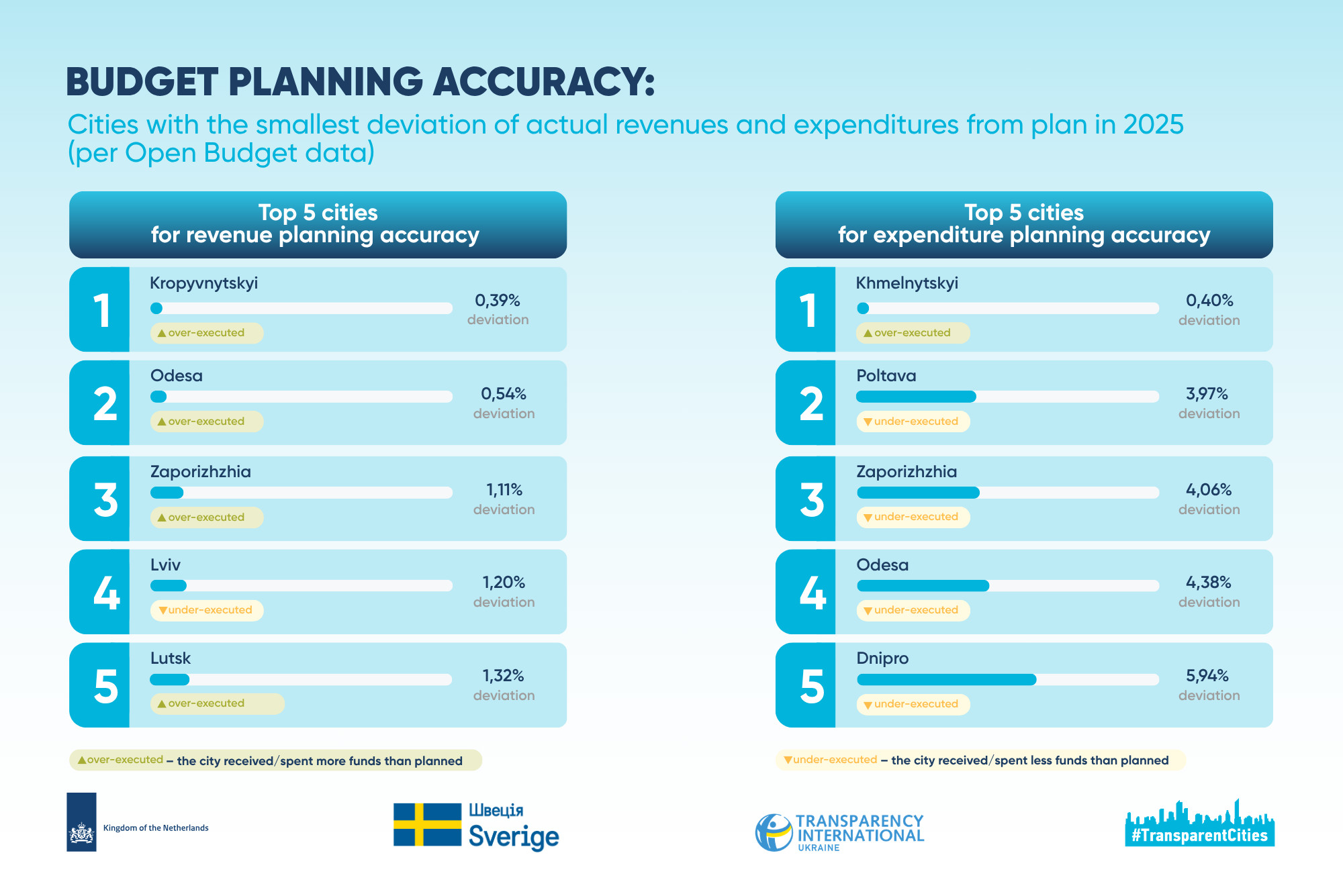
Kharkiv showed the lowest budget planning accuracy: the city under-executed its budget plan by more than 14% on both revenues and expenditures. According to the report on the execution of the Kharkiv territorial municipal budget for 2025, the main reason was the non-receipt of a state budget subvention for the extension of the third metro line, in the amount of UAH 2,090.1 million. This is important context: Kharkiv's deviation is largely driven by external factors.
Analysts also examined the budget balance of each municipality — the difference between actual revenues and expenditures. Based on 2025 results, only Poltava ended the year with a surplus (actual revenues exceeded expenditures) and met the corresponding indicator. The other 10 cities in the sample closed the reporting period with a deficit.
All cities under review performed worst on publishing budget program passports and execution reports on the Open Budget portal. Main spending administrators in Kyiv, Kropyvnytskyi, Poltava, Kharkiv, and Khmelnytskyi did not publish a single document. Analysts credited only Lviv and Odesa with passport availability, since both posted documents from city council departments implementing policy in the five priority areas — finance, healthcare, education, social policy, and housing and utilities.
The reporting indicator was not met by any city. Reports on budget program passports of individual administrators were published on the Open Budget portal in Dnipro, Lutsk, Lviv, and Odesa, but no city had reports on passports for at least the five priority areas.
Working with Prozorro and Prozorro.Sale
To assess how comprehensively and effectively local self-government bodies handle procurement and the management of municipal property, analysts drew on data from two electronic systems: Prozorro, where communities procure goods and services with budget funds, and Prozorro.Sale, where cities, conversely, generate revenue through privatization, leasing of municipal property, and land auctions.
To gauge the quality of city councils' procurement work, analysts focused first on the Contracting Authority Index across all recipients and administrators of budget funds of the local self-government bodies for 2025. The Contracting Authority Index is a composite indicator developed by the DOZORRO project of Transparency International Ukraine. A high Index reflects greater performance, openness, competition, and fewer violations in procurement. The average Contracting Authority Index for 2025 across the 11 cities was 36.4. Kyiv had the highest score (40.1) and Lviv the lowest (32.2). At the same time, a city's Contracting Authority Index reflects the aggregate performance of various subordinate organizers. To understand the reasons behind specific results, the practices of individual divisions and institutions need to be analyzed.
The criterion that captures procurement competition — the average number of bidders — was close in this sample to the national average. On average, the 11 cities attracted 1.86 bidders per procurement in 2025 (against a national average of 1.9). The share of competitive procedures with two or more bidders averaged 35.98%.
A separate point concerns the ability of city councils and their subordinate institutions to attract unique bidders to their procurement. In 2025, the average across the sample was 4,529 unique bidders. Kyiv predictably topped the list with 12,708 unique bidders, reflecting the much higher concentration of business in the capital. The fewest bidders were attracted in Kropyvnytskyi (2,131). Because of differences in market size, the criteria on competition and unique bidders carried relatively little weight in a city's final score.
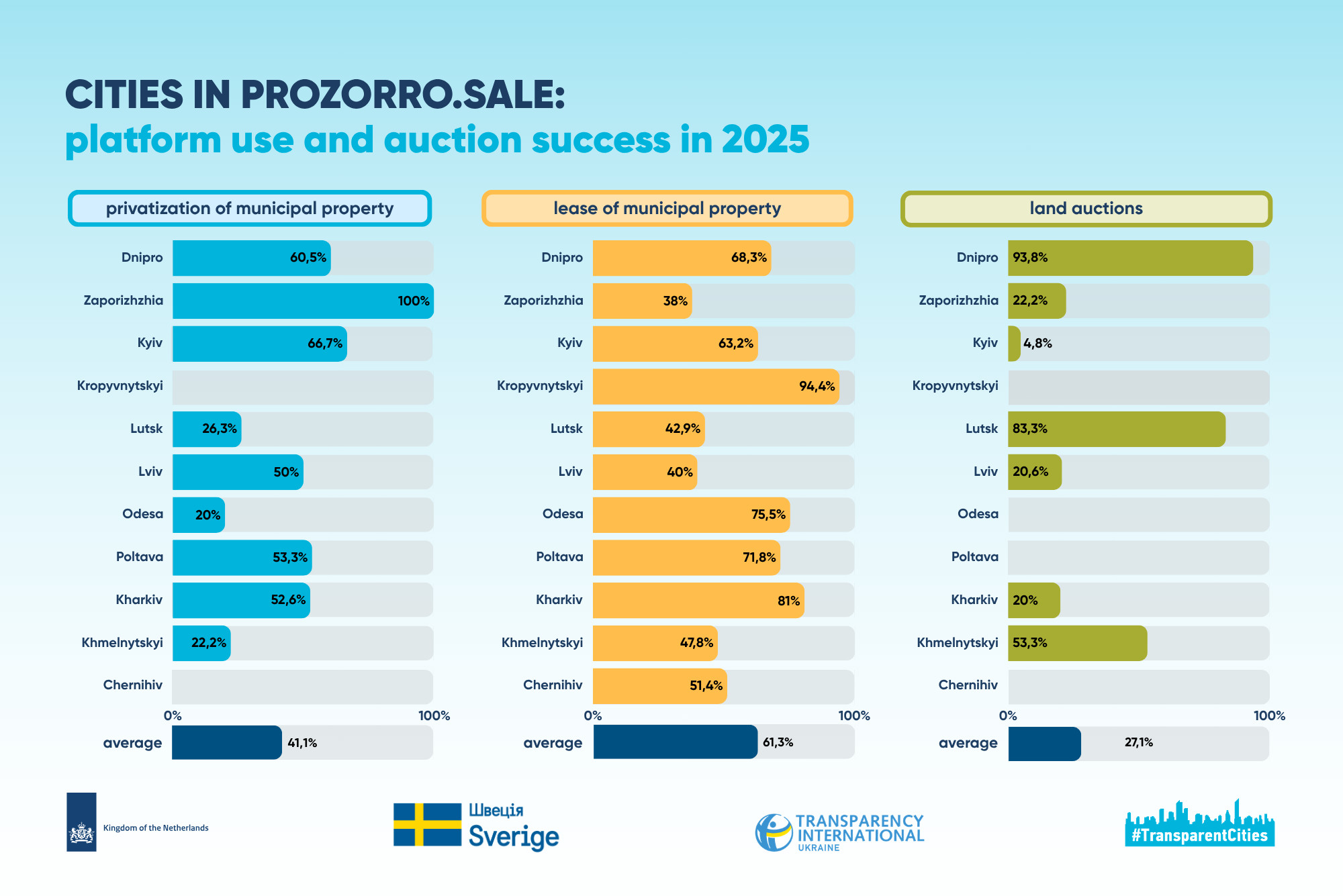
To assess the effectiveness of community asset management, analysts checked whether cities used Prozorro.Sale for three types of procedures: privatization, leasing of municipal property, and land auctions. How actively the platform is used reflects local authorities' ability to manage community assets effectively. Most cities under review have integrated the platform into their work: all 11 municipalities used Prozorro.Sale in 2025 for auctions on the lease of municipal property. Kropyvnytskyi and Chernihiv recorded no small-scale privatization procedures, however, and besides those two cities, Poltava also held no land auctions through the electronic system.
Analysts also assessed the level of competition and the share of successful auctions as indicators of the market appeal of municipal assets and of how well lots are prepared. Above-average competition (by number of bids) on small-scale privatization was shown by Dnipro, Kyiv, and Lviv, and on the lease of municipal property by Kyiv, Lviv, and Kharkiv. Overall, leasing was the most active segment: on average, cities held more than 140 auctions and attracted more than 180 bids. By comparison, small-scale privatization and land auctions averaged fewer than 30 procedures and up to 50 bids.
The lowest competition — the smallest number of bids per auction — was recorded in Zaporizhzhia and Khmelnytskyi (privatization), Kropyvnytskyi and Lutsk (leasing), and Zaporizhzhia, Kyiv, and Kharkiv (land auctions). Even given the objective security risks faced by frontline cities, the level of competition at auctions depends primarily on how proactively city councils prepare and promote lots.
In the end, only Dnipro managed to deliver above-average success rates across all three auction types. This is one of the reasons for Dnipro's leadership in this study. Organizers in Poltava, Kyiv, and Kharkiv met this indicator on municipal property (privatization and leasing), but could not match those results on land auctions. Only Dnipro, Lutsk, and Khmelnytskyi achieved a high share of successful procedures in land management, while for the rest, this remained the most difficult area.
In April, the State Audit Service of Ukraine confirmed to Transparency International Ukraine that the state financial audit of the Lutsk territorial community budget for 2020–2025 had identified financial violations resulting in significant losses. The audit covered the city council's executive bodies and a number of municipal enterprises, including in construction, housing and utilities, education, social policy, and healthcare.
Lutsk earned solid marks for information availability, but the financial violations identified by auditors for 2020–2025 show that even open information does not guarantee the effective use of funds. On indicators of efficiency in managing community finances and assets, Lutsk scored significantly worse.
In particular, the Capital Construction Department of the Lutsk city council, where the State Audit Service of Ukraine identified the key episodes of financial irregularities, showed a very low level of competition in procurement and did not publish any documents on the Open Budget portal.
That is precisely why openness is necessary but not sufficient. It creates the conditions for oversight, but public and institutional scrutiny remain indispensable. Citizens need to be engaged in shaping budget decisions — both at the formation stage and in monitoring how funds are spent — to prevent abuses of this kind.
Key findings and recommendations
The average performance on the “Public Finance” block is mediocre — 44.4%. No city scored more than 60 points, and none combined sufficient transparency with efficient management of community resources. There is no example of a comprehensive approach: city councils did not show strong results across the key dimensions — from information availability and budget planning accuracy to effective procurement and asset management.
The leaders of the block earned their positions on the strength of a single dimension. Dnipro and Kyiv scored well on budget planning accuracy (per Open Budget data) and active use of Prozorro.Sale, but did not provide adequate public access to key documents. Lutsk and Khmelnytskyi, by contrast, populated their budget sections well but trailed badly on the rest of the criteria.
All cities supplied contracting authority hierarchies for the BI Prozorro analytical resource and used Prozorro.Sale for municipal property leasing auctions. 9 of 11 municipalities also held small-scale privatization procedures on Prozorro.Sale and created a dedicated thematic section on public procurement.
Yet no city published, in a dedicated budget section, the list of public proposals to the draft 2026 budget, and none ensured the publication of execution reports on budget program passports on the Open Budget portal. 10 of 11 cities did not publish minutes of public hearings on the draft budget or the results of consultations with business on procurement, and they failed to deliver a budget surplus in 2025.
The study shows: local authorities mostly publish the key documents on the budget process, but handle communication on public engagement poorly. This applies to consultations with business on improving procurement, public hearings on the draft budget for the next year, and the processing of resident proposals collected through various channels. Even among the leaders (Dnipro), this is one of the most serious problems. Budget openness is defined by the quality of dialogue with the community: the inclusion of different social groups, the creation of platforms for exchanging views and proposals, and the communication of results.
At the same time, despite wartime challenges, large Ukrainian municipalities maintain basic governability and budget discipline. The performance of the cities under review is in line with widely recognized European standards. In particular, revenue planning accuracy in most municipalities deserves the highest “A” rating under the international PEFA methodology (criterion: execution at 97–106%). The average deviation of actual revenues from plan was just 3.08%. Although the overall execution range runs from 85.3% (driven by Kharkiv's result, given the unprecedented wartime challenges it faces) to 104.8%, most of the cities analyzed comfortably meet the international benchmark.
The findings also show that proximity to the front is not a decisive factor in resource management performance. Cities with similar security conditions deliver different results. For example, Kharkiv and Zaporizhzhia, both on the List of Territories of Potential Hostilities, met significantly more procurement and asset criteria than Chernihiv, which faces constant security challenges as well. A correlation analysis confirmed that the security factor (status as a territory of potential hostilities) does not affect procurement and asset management results.
The program recommends that all cities (not only those in the pilot sample) take the analytical findings into account, namely:
In the budget process:
- Create or expand a single thematic section on the official website devoted to the local budget. Ensure that the information in this section is structured and includes at least:
- The council's budget regulations (if there are none, consider drafting and approving such a document to organize a transparent budget process)
- The decisions approving the budget for the current and previous years, with all amendments made during the year reflected in a single document
- Documents on budget planning for the current and coming years: the budget forecast, budget requests of main spending administrators, and so on
- Documents on local debt management, such as the Local Debt Management Program
- The list of main spending administrators with their USREOU codes and an indication of the data's currency
- Links to relevant resources: the territorial community profile on the Open Budget public web portal and the Spending portal (the Unified Web Portal for the Use of Public Funds). The latter link is best placed next to the list of main spending administrators.
- The full cycle of information on public engagement in the budget process.
- Proactively engage the public in budget planning, in particular by holding public hearings on the draft budget for the next year and by collecting proposals electronically. Process all proposals received and communicate the results in a structured way in the thematic section on the official website. It is important to publish lists of public proposals on the draft local budget for the next year, including proposals received during public hearings and through other forms of soliciting public input.
- Consider engaging subject-matter experts to refine approaches to short- and medium-term budget planning. Exchanging experience with other cities may also be useful for establishing best practices in budget planning under full-scale war. We also note that effective management of budget funds requires proper internal control — in particular, internal audits using a risk-based approach.
- Main spending administrators should publish budget program passports and execution reports within the established deadlines — passports within three working days of approval, and reports within three working days of submission of annual budget reporting — in open data format, that is, on the Unified State Open Data Web Portal (data.gov.ua) and on their own websites.Publishing passports and reports on the Open Budget public web portal is a best practice and helps make these documents available to a wide range of citizens and experts.
In public procurement:
- Create or expand a single thematic section on the official website devoted to public procurement. Ensure that information in this section is structured and includes, where applicable:
- Documents regulating procurement in the community, for example, a Procurement Policy (if one has been drafted), justifications of the technical and quality characteristics of procurement subjects (under CMU Resolution No. 710), and others
- Announcements of pre-tender consultations or discussions with business and information on the results of these consultations.
- To raise the Contracting Authority Index and improve results on other procurement criteria, attention should be paid to the quality of procurement by subordinate organizers across four groups of indicators:
- Performance: If the share of successful procurement by a given organizer is low, or there are many canceled procedures, it may be worth revisiting approaches and policies for pre-tender work and market analysis. This may signal that tender documentation is insufficiently developed and that technical requirements do not match the offers available on the market.
- Competition: A small number of bidders indicates that the organizer's procurement is not sufficiently attractive to the market. The problem may lie in insufficient awareness among potential bidders of upcoming procurement, short timelines for clarifications and bid submission, or unclear descriptions of the procurement subject, payment terms, and so on.
- Openness: This indicator is affected by lots that were disqualified or that drew many questions or demands. Tenders with disqualifications or numerous questions need to be identified and analyzed for their causes. It is also worth checking whether bidders need more detailed instructions or clarifications of the stated requirements.
- Rule compliance: Following the law in procurement is essential to minimize the number of confirmed violations identified by State Audit Service monitoring and complaints upheld by the AMCU. A high number of recorded violations negatively affects market trust in the organizer's procurement and all of the preceding indicators.
These indicators for a city's organizers can be reviewed directly in the Contracting Authority Index tool. More detailed descriptions of each indicator and recommendations for improving them are available at the link. To improve procurement, more active engagement with the market is also needed — through consultations and discussions with businesses.
- To analyze the work of divisions, enterprises, institutions, and organizations subordinate to the city council on your own, build and update a contracting authority hierarchy in the BI Prozorro analytics module. This will let you review detailed indicators across the entire hierarchy and for each individual organizer in one place and identify problems in time. The result is improved procurement quality both for individual organizers and for the community as a whole. We also recommend adding the hierarchy of contracting authorities subordinate to the city council to the dedicated thematic section on public procurement.
- To independently analyze the performance of the units, enterprises, institutions, and organizations subordinate to the city council, create and maintain a contracting authority hierarchy in the BI Prozorro analytics module. The instructions are available here. This lets you view detailed metrics for the entire hierarchy and for each individual contracting authority in one place, and identify problems in good time. Ultimately, it will help improve the quality of procurement by individual contracting authorities and across the community as a whole. We also recommend publishing the hierarchy of contracting authorities subordinate to the city council in a dedicated public procurement section.
In asset management:
- Use the Handbook for Local Self-Government Bodies prepared by the Prozorro.Sale team to optimize privatization, leasing, and land auctions.
- Analyze the level of competition at auctions of different types: privatization or leasing of municipal property and land plots. The ability to attract more bids depends largely on the quality of lot preparation and on how auctions are publicized. To improve these elements, the place to start is updating and publishing information on property available for privatization or lease. This can encourage potential buyers and tenants to initiate auctions. The next steps are to prepare detailed descriptions of objects with photos and realistic starting prices, and to publicize auctions more actively on city council websites and other platforms.
- Step up and improve work with land auctions. Land auctions can be an important source of revenue for the local budget, so the existing List of Land Plots Subject to Lease or Privatization should be reviewed and auctions held through the electronic system, following detailed recommendations.
Budget transparency is more than access to information. It is also the real ability of residents to influence decisions and to understand how public money works for the community's development. It builds trust, but more than that, it shapes the quality of the management decisions that affect the life of cities today and in the future.
In wartime, when resources are limited and needs are growing, every budget decision carries a higher cost. That is why openness, accountability, and citizen engagement are no longer add-ons, but baseline conditions for resilience and recovery.
Ultimately, the key question is whether cities are ready to build systems in which transparency is the norm — the norm that will define the quality of life in Ukrainian communities in the years to come.
The program will prepare tailored recommendations for each city council covered by the study, to serve as roadmaps for improving the practical operation of electronic services. The indicator-by-indicator results for each city are available at the link.
For cities not included in the pilot study, the program team has prepared a self-assessment form to gauge alignment of the sphere with European standards.
This research is made possible with the support of the MATRA Programme of the Embassy of the Kingdom of the Netherlands in Ukraine, and with the financial support of Sweden within the framework of the program on institutional development of Transparency International Ukraine.
Content reflects the views of the authors and does not necessarily correspond with the position of the Embassy of the Kingdom of the Netherlands in Ukraine or the Government of Sweden.