None of the 11 municipalities studied achieved a high overall score in the European City Index 2025. The average score was 44 points out of 100, with results ranging from 29.9 to 54.8. However, the study showed that Ukrainian cities already apply many practices typical of European good governance, from basic openness and digital services to corruption risk management and citizen engagement. The main problem is that individual good practices do not add up to a coherent, sustainable governance system.
These are the findings of the first annual European City Index study, conducted by Transparency International Ukraine's Transparent Cities program. In 2025–2026, analysts examined six areas of work of 11 city councils: openness, e-services, open data, public finance, integrity and anti-corruption, and accountability. The pilot sample included 11 cities: Dnipro, Zaporizhzhia, Kropyvnytskyi, Lutsk, Lviv, Odesa, Poltava, Kharkiv, Khmelnytskyi, Chernihiv, and Kyiv.
The team automated some of the Euroindex checks using data from state systems and portals. This made it possible to assess factual data on city council activity separately and to reduce subjectivity.
Kyiv, Lutsk, and Lviv were the top three scorers in the pilot Euroindex. Kyiv scored 55.3 points out of 100, Lutsk 53.4, and Lviv 53.3. Even these large cities, then, still have a long way to go toward full transparency and accountability, and considerable room to improve.
The Euroindex revealed a paradox. Ten of the 11 cities made the top three in at least one of the six subindices, yet no city council was strong in every area at once.
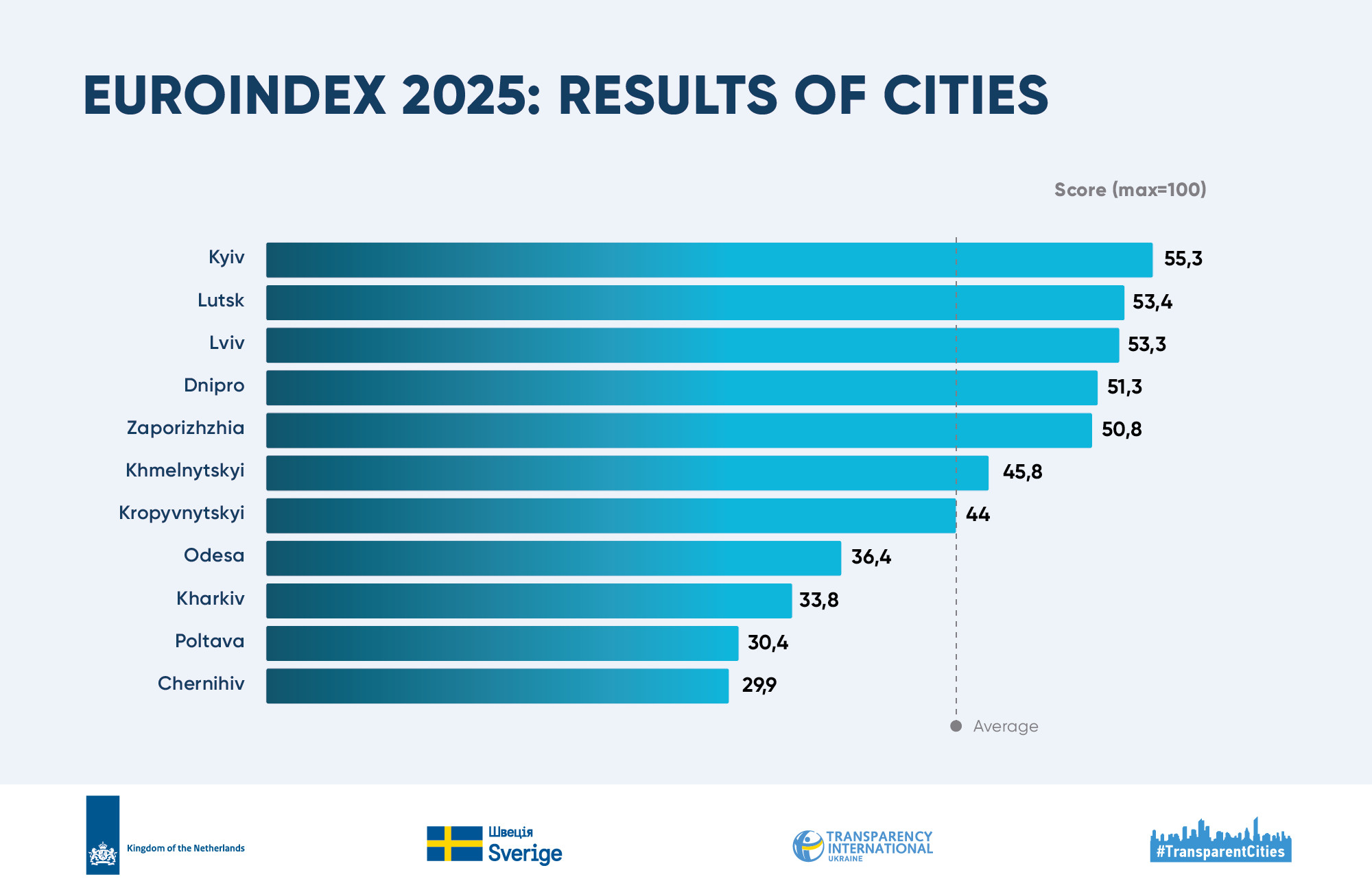
Dnipro led in openness and public finance, Kyiv in e-services and open data, and Lutsk in integrity and accountability. Zaporizhzhia ranked among the best in accountability and integrity, Odesa in openness, and Kharkiv in e-services. Chernihiv was the only city that never made the top three.
What already works in Ukrainian cities
Cities performed best on basic openness, with an average implementation level of 53.5%. Almost all municipalities publish decisions of city councils and executive committees and mayoral orders. They also provide access to territorial community charters, rules of procedure, and other key documents.
E-services have also gradually become part of everyday city life. Real-time public transport tracking, cashless fare payment, online kindergarten enrollment, e-petitions, contact centers, and online booking at Administrative Service Centers are already in place in most of the cities studied. The average score for this subindex was 49.8%, and Kyiv's 70 points for e-services was the highest individual score in the entire Euroindex.
The study also showed that proximity to the front line adds challenges and affects the quality of governance. It does not, however, prevent cities from building transparent processes and engaging residents in co-creating city life. The average Euroindex score of the three cities designated as territories of potential hostilities (Zaporizhzhia, Odesa, and Kharkiv) was 40.3 points, against an overall average of 44. Yet each of these cities posted strong results in individual areas.
Obstacles on the path to the EU
One of the key findings of the Euroindex is that formal compliance often prevails over substance.
“A city council may publish open data, but the data may be outdated or unfit for reuse. It may set up a commission on compensation for damaged property but not publish aggregated results of its work. Or it may hold budget hearings without showing residents what proposals they submitted and what happened to them. Likewise, having an anti-corruption unit in the city council does not guarantee that the results of its work are made public,” explained Olesia Koval, Transparent Cities Program Manager.
That is why, under the European City Index, analysts first assess whether a given section, document, service, or procedure exists, and then how accessible, clear, and usable it is.
A cross-cutting principle of the study was the “single point of entry,” an approach linked to the European principles of user-centricity and one-stop shops. Information on a given topic should be gathered in one clear place.
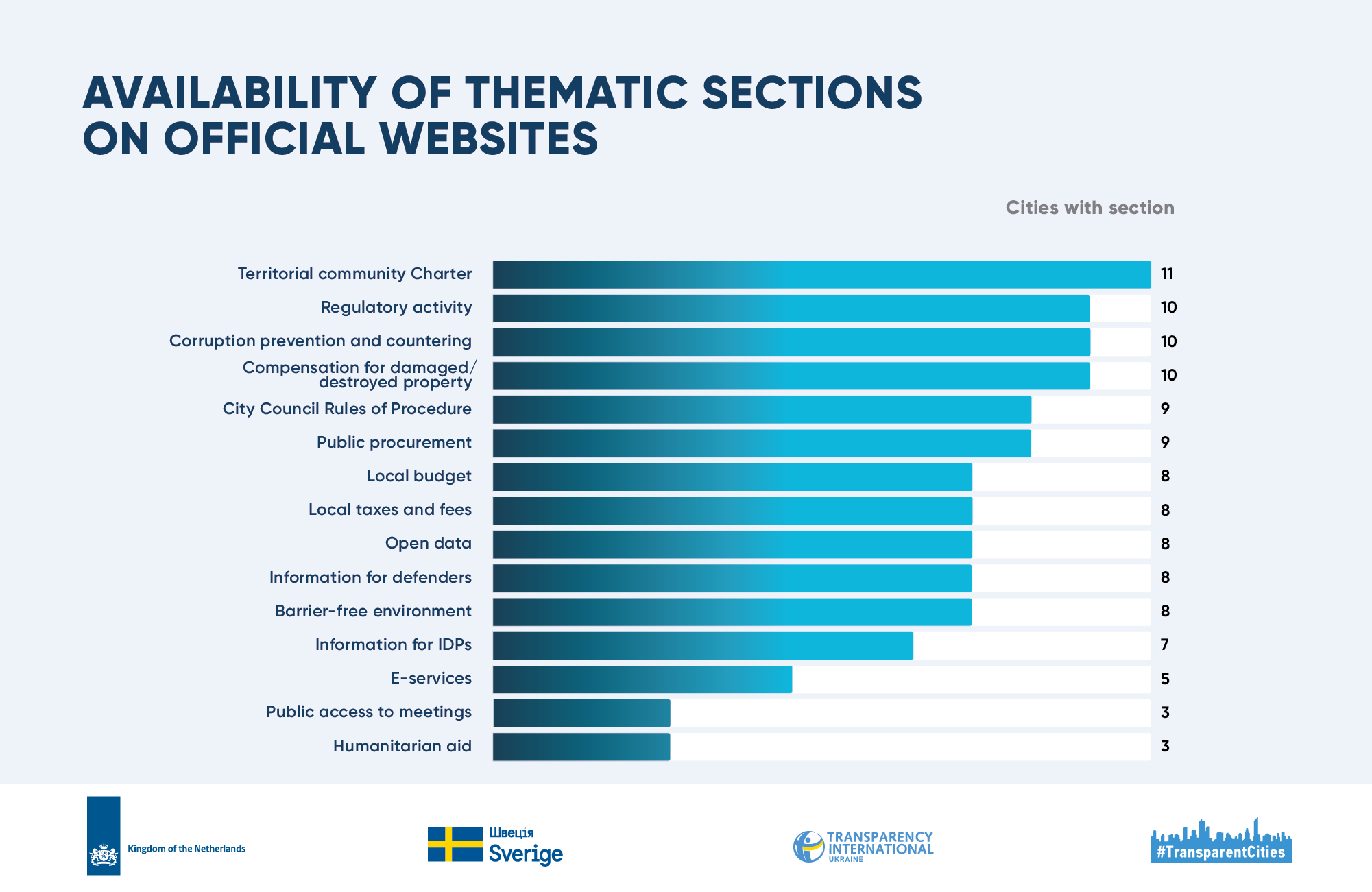
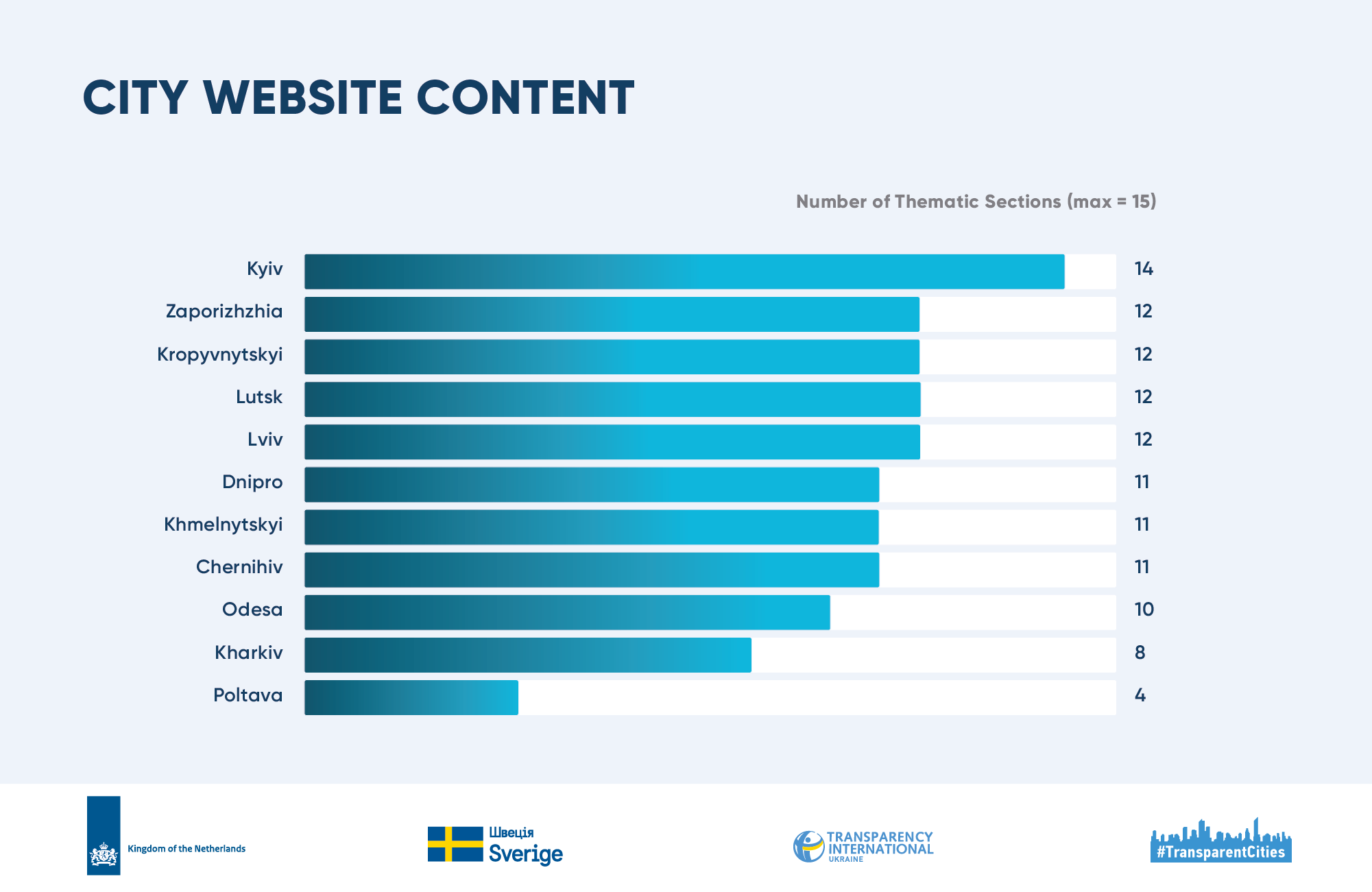
The checks found that the relevant website sections existed in 71% of cases, but only some cities have made this approach systematic so far. Kyiv had 14 of the 15 single points of entry checked, and Zaporizhzhia, Kropyvnytskyi, Lutsk, and Lviv had 12 each. Poltava had only 4. Cities did worst at structuring information on public access to city council sessions and on humanitarian aid: only three of the 11 cities had the relevant points of entry.
Strategic planning also proved to be a systemic problem. Only 3 of the 11 cities (Kyiv, Kropyvnytskyi, and Lutsk) had a current territorial community development strategy in 2025. Yet at the time of the check, none of them had published a 2025 strategy implementation monitoring report on the relevant thematic page.
Feedback between local authorities and the community was another clear weak spot. Only 4 of the 11 mayors (those of Dnipro, Zaporizhzhia, Lviv, and Poltava) reported on their 2025 work at an open meeting with the community. And no city published the text of the mayor's report seven calendar days before the meeting in the manner required by law.
Budget participation is equally telling. None of the 11 cities published a full list of public proposals on the draft 2026 budget in its thematic budget section. Ten cities did not share the minutes of public budget hearings or the results of consultations with businesses on procurement.
Open data was the weakest area of the Euroindex, with an average implementation level of just 23.1%. However, this result cannot be attributed to city councils alone: some of the problems are systemic and depend on national policy and national digital infrastructure. In particular, certain datasets of frontline cities remain closed for security reasons, and automatic data transfer from local portals to data.gov.ua works irregularly. As a result, cities may hold data on their own resources, but it is not always available, up to date, or correctly displayed on the national portal.
“The European City Index works as a mechanism for practical change in communities. After each wave of the study, Transparent Cities sent city councils roadmaps for change, held consultations, and rechecked individual practices. For example, cities began publishing aggregated information on compensation for damaged property, and Kyiv, Lviv, and Poltava created dedicated website sections on e-services. Overall, in the follow-up monitoring, the average score rose by 11.5 points in openness and by 7.6 points in e-services,” said Olesia Koval, Transparent Cities Program Manager.
The European City Index pilot is now complete. The next stage is to scale the study up to 50 cities, further automate the checks, and develop the BI platform where city results can be viewed and compared. The program will also continue to use the Euroindex for consultations with communities, training, and advocacy for systemic change.
Detailed results, the methodology, city profiles, and recommendations are available on the Transparent Cities website. City councils not included in the pilot study can use the self-assessment forms and contact the program for advice.
This research was prepared with the support of the MATRA Programme of the Embassy of the Kingdom of the Netherlands in Ukraine and with financial support from Sweden within the framework of the Transparency International Ukraine institutional development program.
The content of this publication is the sole responsibility of the authors and does not necessarily reflect the official position of the Embassy of the Kingdom of the Netherlands in Ukraine or the Government of Sweden.