In 2025, the Transparent Cities program launched a pilot study format to assess how ready Ukrainian cities are for EU integration. The criteria of the European City Index are aligned with key EU integration documents. The program's experts have already examined how municipalities ensure openness on their websites, manage electronic services and open data, and handle public finance. The fifth stage of the research focused on analyzing the integrity sphere, whose proper functioning represents one of the essential conditions for Ukraine's EU integration.
Ukraine scored 36 points out of 100 possible in the Corruption Perceptions Index (CPI) for 2025 and ranked 104th among 182 countries in Transparency International's global study. The results of all our Eastern European neighbors—Moldova, Poland, Romania, Slovakia, and Hungary—proved higher. Denmark, an EU member, topped the Index with 89 points, and five other Western European EU members ranked in the top ten.
The latest sociological research by Transparency International Ukraine revealed that the vast majority of Ukrainians regard corruption as a mass phenomenon—87% of respondents reported this view. Moreover, more than half of Ukrainians believe the authorities are inactive in combating corruption (51%), while nearly three-quarters (73%) are convinced that this problem can only be resolved through systemic reforms.
Against this backdrop, it becomes clear why fighting corruption has become one of the core priorities in Ukraine's negotiations for EU membership. Scarcely a single document—whether it be European Commission Reports on Enlargement, the Ukraine Facility Plan, or the agreed EU criteria for Ukraine across three priority clusters—lacks extensive references to anti-corruption and rule of law reforms. Although these documents primarily discuss the need for reforms at the national level, corruption at the local level also significantly undermines public trust in the country and signals that democratic institutions are not functioning sufficiently effectively.
Local governments have always controlled substantial resources: budgets, land, and municipal property; and during wartime, these resources were supplemented by millions of euros in international aid. For these millions to eventually transform into billions in investment for recovery and the realization of other projects, local self-government bodies must now act with maximum transparency, responsibility, and demonstrate genuinely systemic work in the integrity sphere. The results of such work should be increased public trust in authorities and confidence from international partners, successful implementation of recovery plans, and, finally, the achievement of the country's EU integration aspirations.
Research methodology
The “EU integration” orientation of this study is grounded in the provisions of the Ukraine Facility Plan and the recommendations of the European Commission's Reports on Enlargement for 2023–2025. In its 2025 Report, the EC noted that Ukraine should improve its anti-corruption system and prevent any backsliding from the significant achievements in reforms.
The indicators in the Integrity and Anti-Corruption block also reflect provisions of the Roadmap on the Rule of Law in the context of EU accession, which calls for strengthening the mandate, capacity, and accountability of authorized units and persons in local self-government bodies responsible for corruption prevention and detection, and empowering them to effectively monitor and support the implementation of Anti-Corruption Programs with the assistance of the National Agency on Corruption Prevention (NACP).
The methodology also accounts for the 10-point reform plan (the “Kachka–Kos Plan”), which prioritizes urgent and high-impact measures in anti-corruption and rule of law. This plan specifically addresses the integration of corruption risk management into organization-wide risk management, and ensuring broad integration of NACP tools into internal control and internal audit practices.
Information on city councils' implementation of integrity indicators was collected in May 2026, with an emphasis on the activities of local self-government bodies during 2025.
The pilot sample included city councils of ten regional capitals (Dnipro, Zaporizhzhia, Kropyvnytskyi, Lutsk, Lviv, Odesa, Poltava, Kharkiv, Khmelnytskyi, and Chernihiv), as well as the city of Kyiv. The selected cities represent various levels of transparency, cover all macro-regions of Ukraine, and reflect different wartime contexts (rear-area cities and cities included in the List of Territories of Potential Hostilities).
The development level of the integrity ecosystem was assessed using 40 criteria. The final score was calculated as the sum of points for each completed indicator, with a maximum assessment of 100 points per city.
Analysts examined:
- The presence of legal regulations that establish anti-corruption and ethical conduct rules;
- Evidence of active work by local self-government bodies (authorized executive bodies, standing commissions) responsible for the integrity sphere;
- The city council's involvement in the functioning of NACP tools;
- Public disclosure of monitoring results on the current anti-corruption situation;
- The absence of mentions of city council officials and council members in databases recording instances of anti-corruption law violations.
Assessment of 19 of the 40 indicators concerning the coverage of anti-corruption issues on the city council's official website was conducted using the “single point of entry” principle. That is, all data for assessment were sought in a separate thematic section of the official website. In the absence of such a section with structured and easily searchable information, a city received 0 points for the corresponding indicators and forfeited 46 out of 100 possible points. It is important to understand that applying the “single point of entry” principle, which is oriented toward user needs, is fundamental when assessing criteria of the European City Index, as it forms the basis of modern governance in the EU.
Since both Kyiv City Council and KCSA have their own authorized units responsible for corruption prevention and detection—the Anti-Corruption Prevention and Detection Department of the Kyiv City Council Secretariat and the Department for Corruption Prevention and Detection of the KCSA—in the case of the capital, experts analyzed two official websites. Due to this specificity, a decision was made to award half the maximum possible points for indicators if both government entities—both the Kyiv City Council and the KCSA—were to implement the relevant indicators, but one did so while the other did not.
In addition to city council official websites, program experts analyzed data from the Unified State Register of Declarations, the Unified Portal for Whistleblower Reports, specific open data sets with NACP activity results, and reviewed the content of 2025 reporting forms from authorized corruption prevention and detection officers on the Integrity Portal. Regarding information on the prosecution of city council officials and members for corruption or corruption-related offenses, the pilot study examined only the High Anti-Corruption Court case registry using the HACC Decided platform. Data from the Unified State Register of Persons Who Committed Corruption or Corruption-Related Offenses were not used, as of May 2026, some registry data regarding the offender's place of employment and position were hidden.
Research results
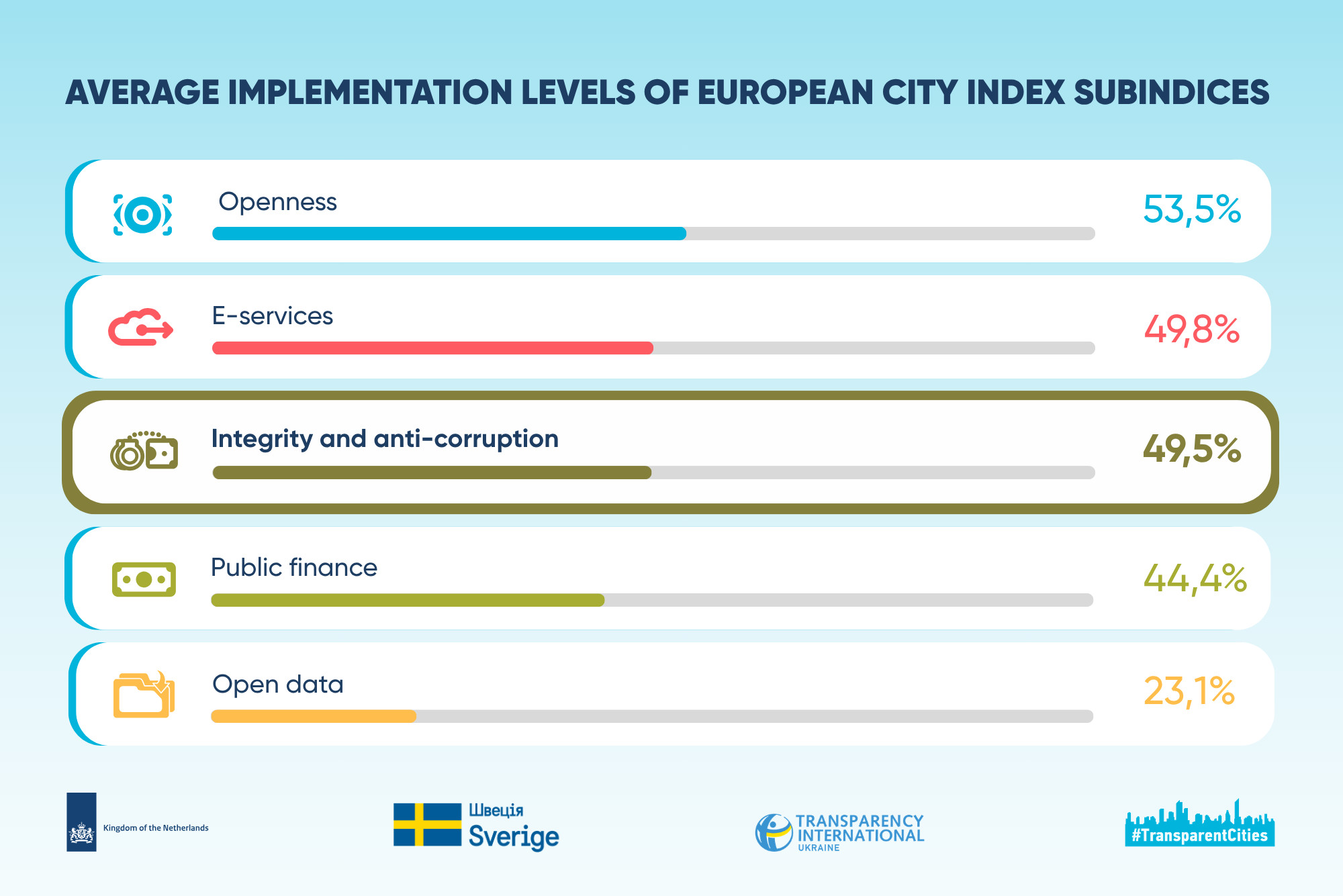
The average implementation rate of the 40 indicators in the Integrity and Anti-Corruption block stood at 49.5%.
Lutsk showed the highest result with 67 out of 100 possible points. One position below was Khmelnytskyi with 63 points, followed by Zaporizhzhia with 61 points. The lowest scores were Odesa (30), Poltava (35), and Chernihiv (36).
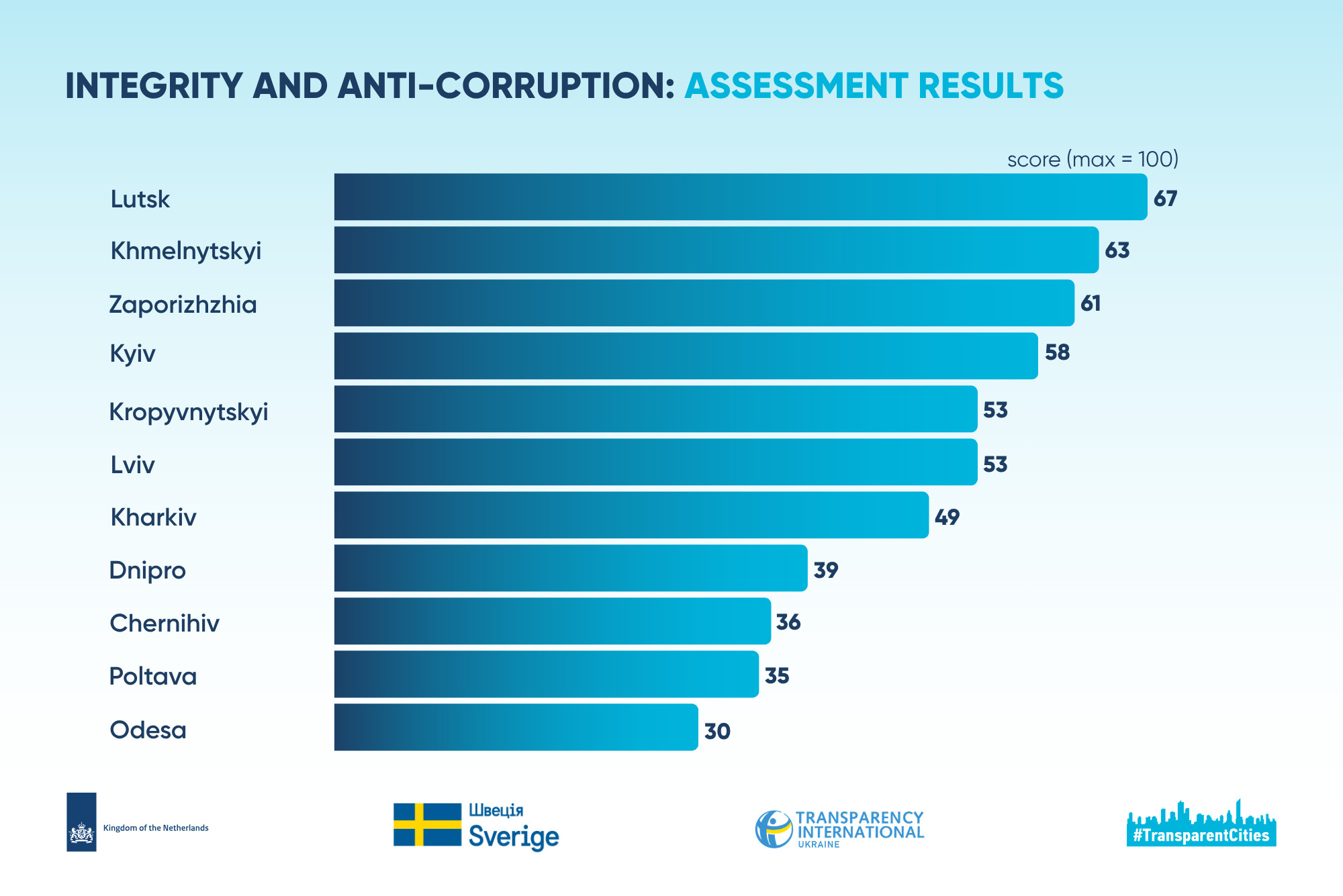
Lutsk became the leader because the municipality established a working group to assess corruption risks, formed its own risk register, and developed an Anti-Corruption Program for 2024–2026. Beyond having a current program, its systematic approach was evidenced by a relevant thematic section on the council's official website. As mentioned earlier, analysts examined the coverage of 19 aspects of anti-corruption activity on this section, and in Lutsk's case confirmed the presence of 11 of them. It is also worth noting that the city council popularizes NACP tools and actively participates in their functioning. Specifically, the executive committee and at least ten municipal institutions are connected to the Unified Portal for Whistleblower Reports, and citizens have access to the agency's methodological materials. The absence of any mentions of Lutsk city council officials and members in databases recording instances of anti-corruption law violations in 2025 also positively influenced the result.
Khmelnytskyi represents another city for which, under Article 19 of Ukraine's Law on Corruption Prevention, developing an Anti-Corruption Program with a corruption risk register is not mandatory, yet the city council followed one last year. The regional center demonstrated strong performance in implementing indicators related to active work by bodies responsible for anti-corruption prevention and ensuring ethical conduct by officials and members. There were almost no mentions of Khmelnytskyi city council representatives in databases recording violations—the sole exception involved a full declaration audit of council member S. Baranska, which revealed signs of inaccurate information. The council's executive committee and at least 10 municipal institutions are connected to the Unified Portal for Whistleblower Reports. Experts also found that the local government body possesses both documents regulating ethical conduct—behavioral rules for officials of executive bodies and the Code of Ethics for Council Members.
Frontline Zaporizhzhia demonstrated strong performance in implementing indicators related to active work in the anti-corruption sector. Systematic work was evidenced by a well-developed thematic section on the council's official website. The city council and at least 10 of its municipal enterprises and 10 municipal institutions are already connected to the Unified Portal for Whistleblower Reports, and by order of the city mayor, regulations establishing mechanisms for whistleblower encouragement were approved. Analysts found no mentions of Zaporizhzhia city council officials and members in databases recording instances of anti-corruption law violations in 2025.
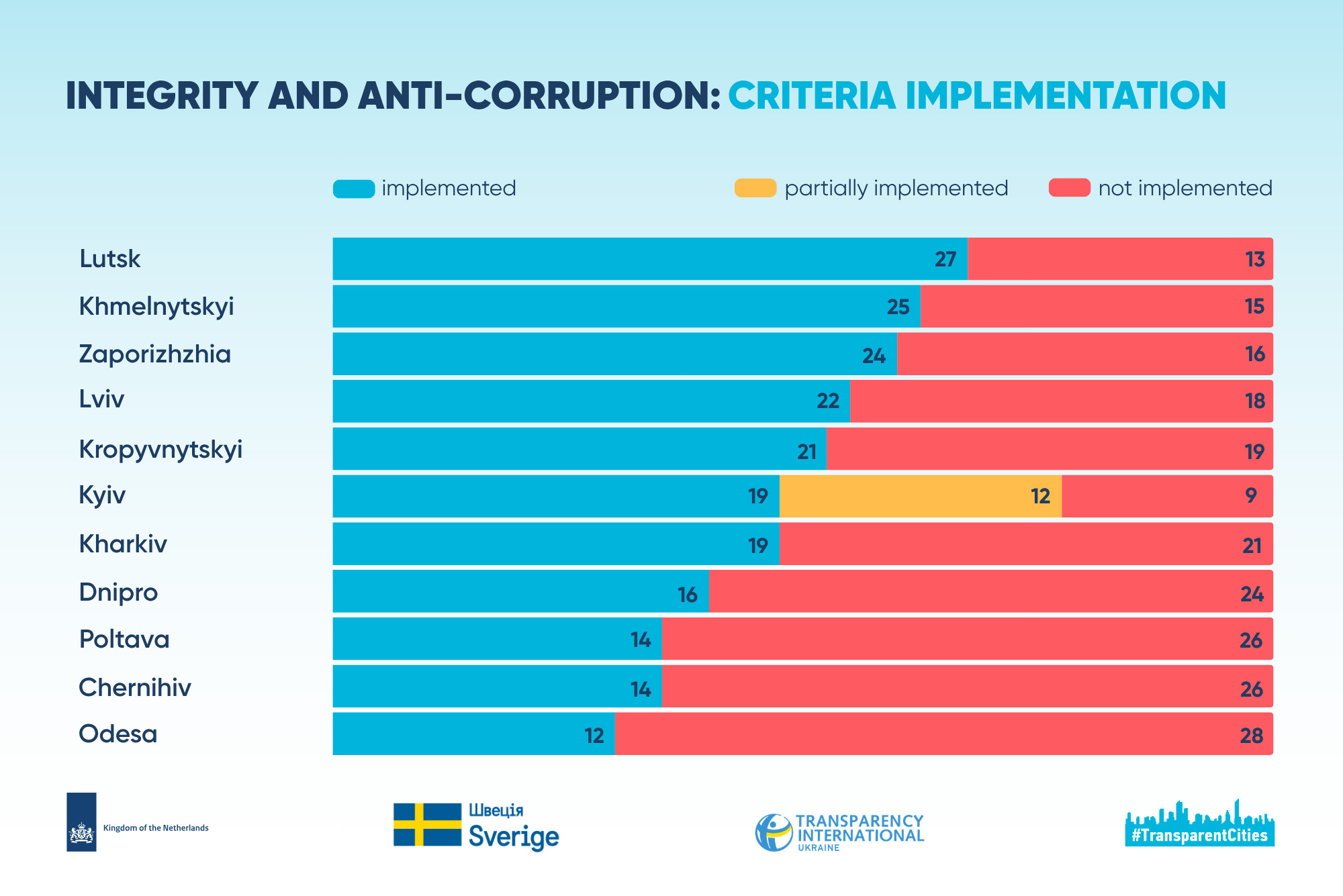
As for the bottom performers, Odesa, Poltava, and Chernihiv share a common problem. These city councils have “single points of entry” on their official websites, but they are nearly empty. Of the 19 links to legal regulations, registers, and methodological materials that analysts assessed, Poltava published only one, while Odesa and Chernihiv each published three. This means authorized units or persons responsible for corruption prevention and detection failed to make proper efforts to structure all available information and consolidate it in the appropriate website section, thereby depriving citizens of convenient access to anti-corruption documents, methodological materials, monitoring results, and other essential information.
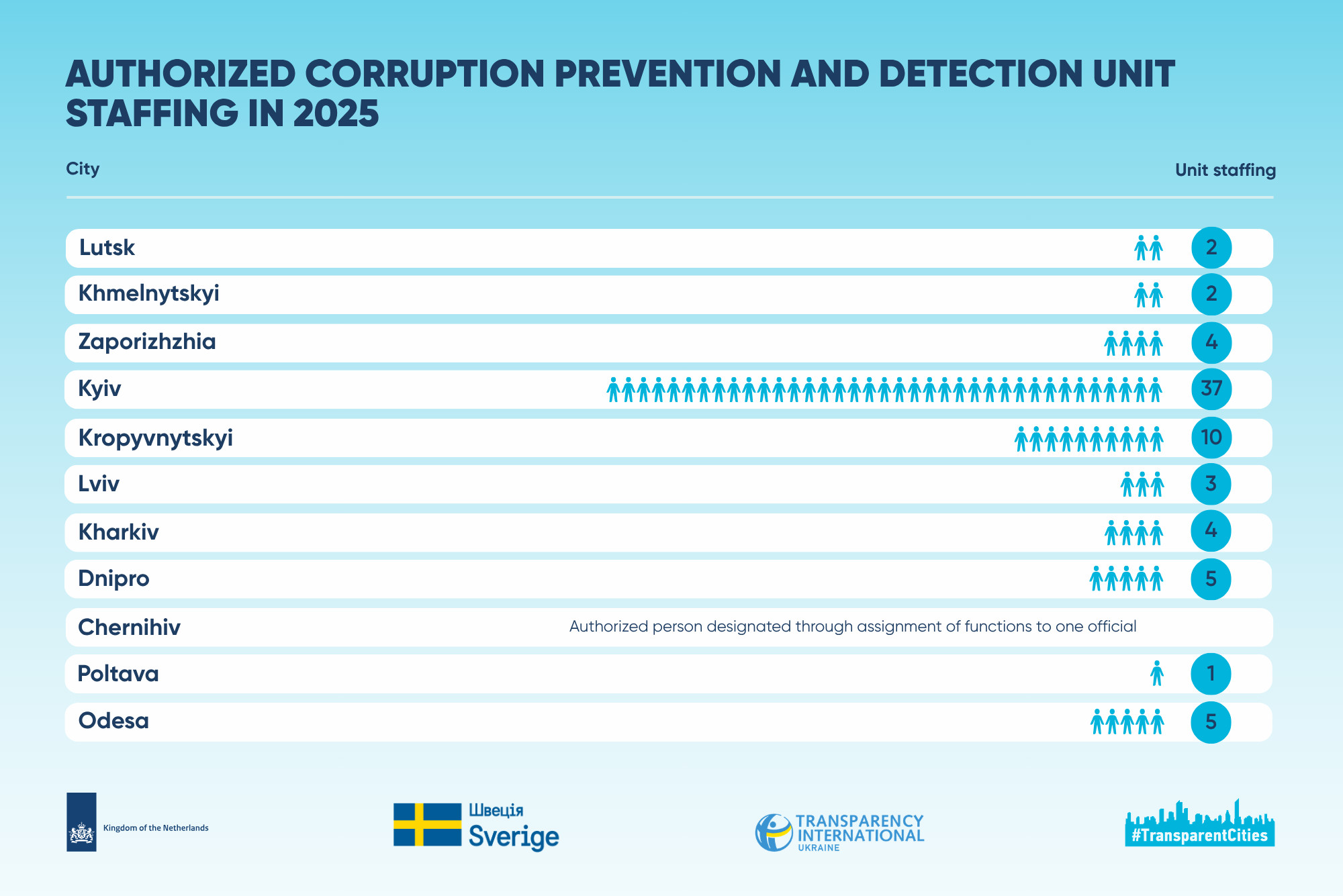
The staffing levels of corruption prevention and detection units, as indicated in 2025 authorized officer reports, did not influence the scores city councils received for implementing the Integrity and Anti-Corruption criteria block. This is evidenced by the Pearson linear correlation coefficient, which equals 0.22 when Kyiv is included, or 0.02 when Kyiv is excluded, where the authorized unit's staffing level is uniquely large.
Strengths and weaknesses
Most successfully, 11 municipalities addressed indicators concerning the absence of mentions of officials and council members in databases recording instances of anti-corruption law violations in 2025. Representatives of Zaporizhzhia, Kropyvnytskyi, and Lutsk did not appear in any of the analyzed databases, while information on representatives of Lviv, Khmelnytskyi, and Chernihiv appeared in only one.
Regarding individual indicators that were well executed, top officials of all studied municipalities ensured timely submission of annual 2025 declarations. Analysts also noted that the NACP database contains no information about reports drawn up for signs of inaccurate information as a result of full declaration audits of officials and members in 11 city councils, which was completed in 2025.
Ten of eleven city councils created a separate thematic section on their official website dedicated to corruption prevention and control (exception: Dnipro), avoided designating an authorized corruption prevention and detection officer through assignment of functions to a city council official (exception: Chernihiv), were not associated with convictions handed down by the HACC (exception: Odesa), and did not give the NACP grounds to draw up reports or issue substantiated conclusions regarding city council officials for violations of conflict of interest or conflict management legislation (in both cases, exceptions were Kyiv).
Regarding the most problematic indicators, not a single city council published a link to the standing council member commission page concerned with corruption prevention in its thematic section (Kharkiv entirely failed to find such a commission, and in Odesa, it comprises one council member and has not convened since November 2021). This is a rather symbolic fact indicating that none of the municipalities have a truly comprehensive, systemic approach to anti-corruption activity, one component of which is the work of the corresponding standing commission.
Furthermore, not a single city council shared with citizens information about the presence or absence in 2025 of official reports concerning conflicts of interest, nor about the presence or absence of council members prosecuted for committing corruption or corruption-related offenses.
Public disclosure of monitoring results on the current anti-corruption situation proved the most problematic area. Of five criteria—two mentioned above were not met by anyone, while the other three were fully or partially met only by Kyiv:
- Kyiv City Council gathered and published detailed information about council members reports of conflicts of interest in 2025 at both plenary council meetings and standing commission sessions;
- Kyiv City Council published information about employees prosecuted for committing corruption or corruption-related offenses in 2025 (whereas the KCSA did not);
- The KCSA disseminated results of monitoring the timeliness of 2025 declaration submission by declaration subjects (Kyiv City Council did not).
Analysts found that Lviv City Council regularly publishes information about coucil member conflicts of interest reports on the Members' Information Portal, but a link to this page is absent from the “single point of entry” on the anti-corruption topic.
Also, 10 cities lack an important practical instrument—a procedure for receiving and reviewing reports of violations of ethical conduct rules by officials and employees of council executive bodies (exception: Lviv).
Unfortunately, the disclosure of foundational documents regulating the integrity sphere in city councils was not among the strengths demonstrated by 11 municipalities:
- The corruption risk register of the city council and its executive bodies;
- An Anti-Corruption Program or plan of measures to prevent corruption;
- A Code of Ethics or rules of ethical conduct for officials and employees of council executive bodies;
- A Code of Ethics or rules of ethical conduct for council members.
Corruption risk registers were disseminated only by those following their 2025 Anti-Corruption Programs—Kyiv, Lutsk, and Khmelnytskyi. A plan of measures to prevent corruption was published in the appropriate thematic section by Zaporizhzhia and Kharkiv. Five other cities that also have thematic sections on their websites—Kropyvnytskyi, Lviv, Odesa, Poltava, and Chernihiv—made no mention of their Anti-Corruption Program or plan of measures current as of 2025.
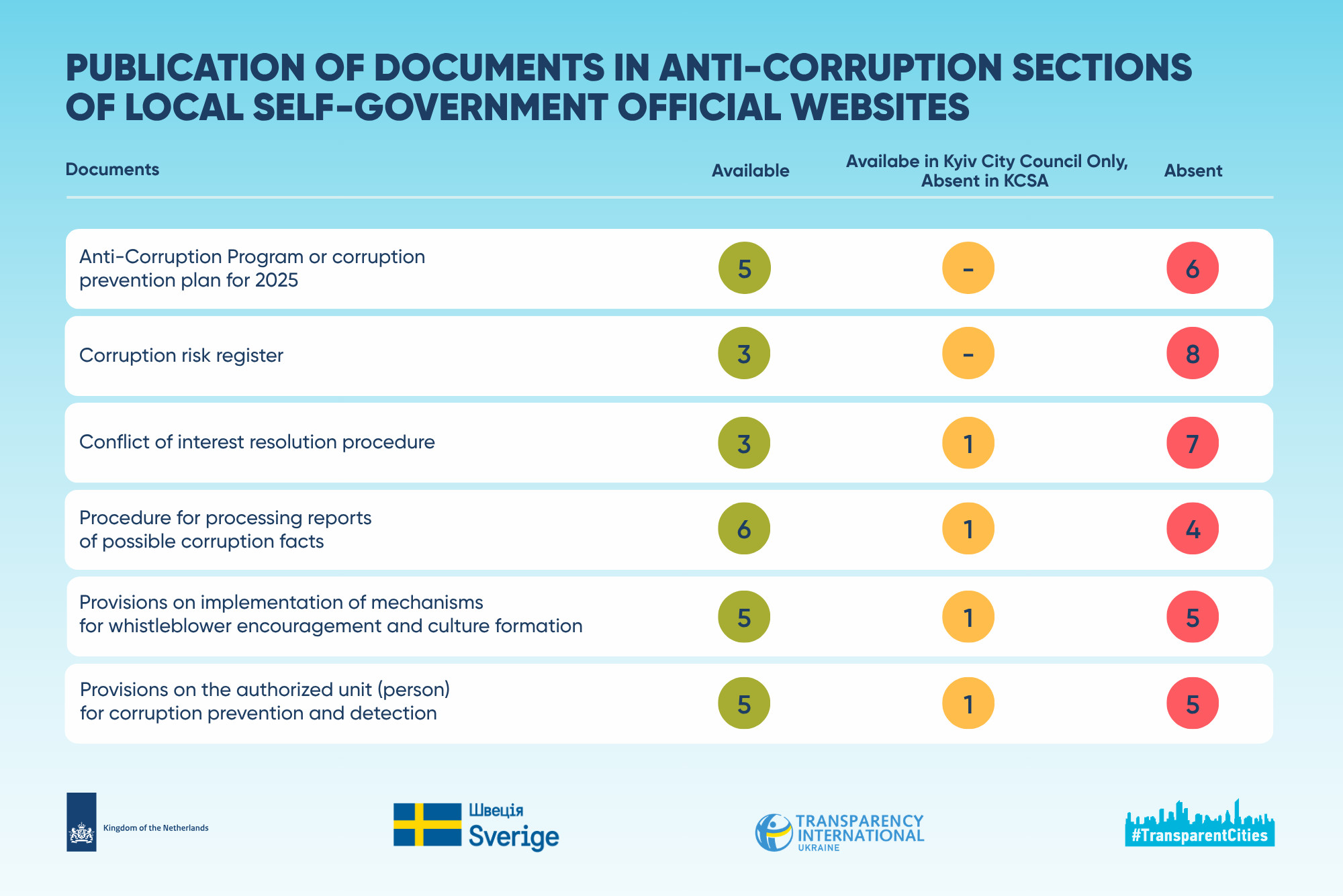
Codes of Ethics or rules of ethical conduct for officials were found on the websites of 6 of 11 councils, while Codes of Ethics or rules of ethical conduct for council members were found on only 3 of 11 council websites—Dnipro, Kyiv, and Khmelnytskyi. It deserves separate mention that Lutsk, Lviv, and Chernihiv have draft Codes of Ethical Conduct for council members, yet their elected representatives have not taken the necessary steps to approve them in recent years.
These facts eloquently demonstrate that systematic work in the integrity sphere has yet to become a widespread practice in regional center city councils across Ukraine.
Special features of Kyiv's assessment
Analysts working on the European City Index encountered for the first time a situation where half of the study's indicators applied to both Kyiv City Council and the KCSA simultaneously. Previously, areas of responsibility between these government entities were more clearly delineated.
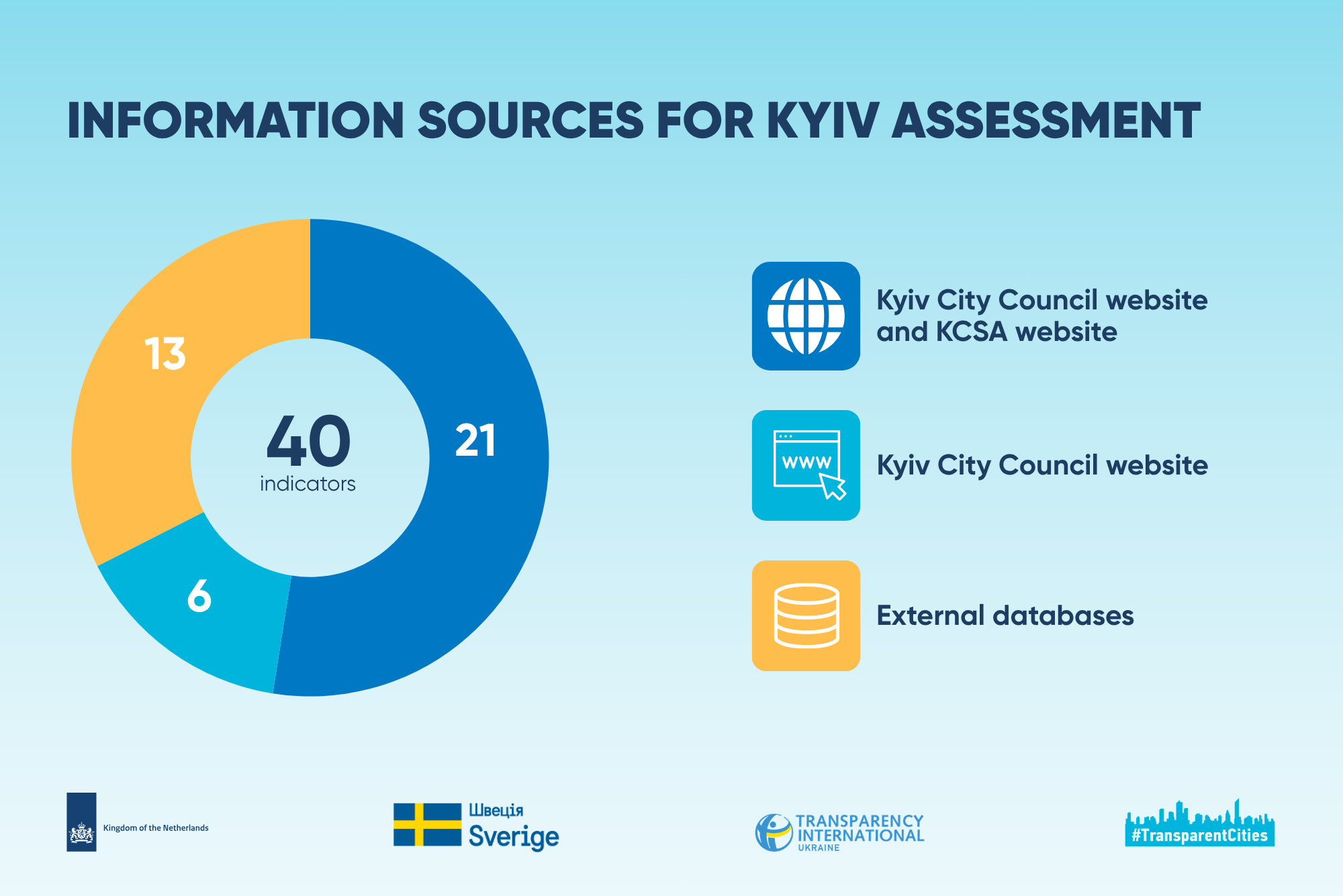
Kyiv City Council implemented 18 of 27 indicators, whereas the KCSA implemented 12 of 21. Had analysts assessed Kyiv based solely on Kyiv City Council's results and external database data, it would have scored 61 points instead of 58 and matched Zaporizhzhia.
Where exactly did Kyiv City Council and the KCSA weaken each other on shared indicators? Unlike the KCSA, Kyiv City Council did not publish in its thematic section: a link to provisions on the Anti-Corruption Prevention and Detection Department, a link to the Unified State Register of Declarations, and results of monitoring the timeliness of 2025 declaration submission by declaration subjects. Also, the capital city council has not yet connected to the Unified Portal for Whistleblower Reports and has not provided website users with a link to this portal.
As for the KCSA, experts found no references on the Department for Corruption Prevention and Detection website to an entire array of legal regulations that should regulate anti-corruption practices and ethical rule violations: the conflict of interest resolution procedure, the procedure for organizing work with reports of possible corruption or corruption-related offenses, provisions on whistleblower encouragement mechanisms, and the Code of Ethical Conduct for Officials. Beyond this, the KCSA did not publish a list of officials prosecuted in 2025 for committing corruption or corruption-related offenses.
The fact that Kyiv ranked as the record-holder among 11 cities for negative mentions in NACP databases also prevented it from scoring high in the Integrity and Anti-Corruption subindex. Based on 2025 results, Kyiv officials or council members could be found in sets titled “Full Declaration Audits,” “Conflict of Interest Reports Drawn Up,” “Substantiated Conclusions on Conflict of Interest Approved,” and “Enforcement Notices Issued from Conflict of Interest Monitoring Results.”
Key findings and recommendations
The average implementation rate for the Integrity and Anti-Corruption block stands at 49.5%, indicating a less developed integrity system compared to openness. The Integrity and Anti-Corruption block results are lower than those for the Openness and E-Services blocks; however, given the particular features of e-services assessment methodology, it can be argued that to date, cities have confidently advanced only in the openness sphere.
The 11 analyzed cities demonstrate very different levels of integrity sphere development. The difference between the highest and lowest city scores is 37 points. This discrepancy can be explained by the fact that in some city councils, authorized bodies make targeted efforts to provide maximum convenient citizen access to documents and materials concerning anti-corruption practices and ethical rule violations, while other city councils make no such efforts whatsoever.
The subindex leaders—Lutsk, Khmelnytskyi, and Zaporizhzhia—achieved their positions by creating separate thematic sections on their official websites dedicated to anti-corruption and publishing current 2025 documents defining anti-corruption policy. These websites contain complete or nearly complete information about authorized units responsible for corruption prevention and detection. The cities were actively involved in functioning NACP tools—top officials submitted timely 2025 annual declarations, and municipalities with at least 10 municipal institutions were connected to the Unified Portal for Whistleblower Reports. Members and officials of these city councils either did not appear or appeared rarely in databases noting anti-corruption law violations in 2025.
Nearly all cities ensured full functioning in 2025 of bodies responsible for anti-corruption prevention and ethical conduct compliance. In 10 of 11 city councils, an authorized corruption prevention and detection officer or unit performed dedicated functions. In 9 of 11 cities, standing commissions responsible for council member ethics and anti-corruption held meetings. The staffing levels of corruption prevention and detection units did not influence the scores received by city councils in the subindex assessment.
The “single point of entry” principle, which is an element of European governance, was applied by nearly all local governments. These “single points of entry” appeared as either separate sections on official websites dedicated to anti-corruption activity or pages of authorized corruption prevention and detection units. Lviv was the only city that unified the anti-corruption theme with ethical conduct in its “single point of entry,” with the authorized unit named “Sector for Integrity and Corruption Prevention.”
Representatives of the studied municipalities rarely appeared in databases recording violations in the past year. Convictions issued by the HACC, negative results from full declaration audits, monitoring of conflict of interest prevention legislation, and related enforcement actions did not touch Zaporizhzhia, Kropyvnytskyi, and Lutsk officials or council members.
At the same time, analysts must note that city councils conduct unsystematic, somewhat chaotic work in the integrity sphere, which only partially meets EU integration requirements. Only 3 of 11 cities had established corruption risk registers and developed Anti-Corruption Programs in 2025; 6 of 11 councils operated under approved Codes of Ethics or rules of ethical conduct for officials and employees of executive bodies; 3 of 11 cities had their own Codes of Ethics or rules of ethical conduct for council members. Khmelnytskyi City Council was the sole local government body demonstrating the presence of all these tools for building an integrity environment.
Only 2 of 11 city councils took necessary steps for the whistleblowing concept to function effectively—Kropyvnytskyi and Kharkiv. In these cities, provisions on whistleblower encouragement mechanisms and procedures for organizing work with corruption reports are approved. City councils, at least 10 municipal enterprises, and 10 municipal institutions are connected to the Unified Portal for Whistleblower Reports, and website users can find links to this portal in the appropriate thematic section.
However, the most problematic area revealed by the study was the nearly complete absence from city council websites of results from monitoring the current situation in the integrity sphere. The results of checks on non-submission or late submission of declarations by declaration subjects; information gathered about official and council member reports of conflicts of interest; records of officials and council members subjected to administrative or criminal prosecution for corruption offenses; and reviews of reports concerning ethical conduct rule violations should be collected by authorized city council bodies and made public. Without them, local governments and the public cannot track the dynamics of corruption and ethical violations, nor draw conclusions about whether corruption risk rates are declining or being eliminated. However, in 2025, only Kyiv of the 11 cities published some of these monitoring results.
The program recommends that all cities (not only those in the pilot sample) take the analytical findings into account, namely:
- Familiarize themselves with the Model Anti-Corruption Program for a Local Council presented by the NACP—a tool offering an approach to managing corruption risks at the community level.
- Establish a working group that will informally analyze the community environment and assess processes where corruption risks may arise. This involves understanding how decisions are made, how different units interact, how resources are distributed, and how municipal, social, and administrative services are provided, and so forth. Form a corruption risk register.
- Identify key performance indicators for integrity sphere work that will reflect actual process changes and reduction in corruption risks. Such indicators may include: implementation of clear procedures and timely response to reports of possible violations; implementation of digital solutions and connection of local governments to online NACP resources; reduction in violations detected during inspections, and so forth.
- If adequate resources are available, even if not directly mandated by law, develop and approve their own Anti-Corruption Program.
- Develop and approve a Code of Ethics or rules of ethical conduct for council members. Include in this document or approve separately a procedure for receiving and reviewing reports of Code or rule violations.
- Develop and approve a Code of Ethics or rules of ethical conduct for officials and employees of council executive bodies. Include in this document or approve separately a procedure for receiving and reviewing reports of Code or rule violations.
- Connect the city council or executive committee to the Unified Portal for Whistleblower Reports. Also, monitor the process of connecting municipal enterprises and institutions to the Unified Portal for Whistleblower Reports.
- Create a separate thematic section on the city council's official website dedicated to anti-corruption and ethical conduct. This section may consist of the following pages: Regulatory Framework, Responsible Bodies, Financial Control, Conflict of Interest, Whistleblowing, Accountability for Corruption and Corruption-Related Offenses, Ethical Conduct, Training, Plans and Reports.
- Publish links on the Responsible Bodies page to:
- The standing council member commission responsible for council member ethics and anti-corruption;
- The authorized unit (person) for corruption prevention and detection;
- The commission for assessing corruption risks in local government activities.
- Regularly publish appropriate monitoring results on the Declarations, Conflict of Interest, Whistleblowing, Accountability for Corruption and Corruption-Related Offenses, and Ethical Conduct pages. Among these:
- Results of verification of non-submission or late submission of declarations by declaration subjects;
- Information about reports by local government officials concerning conflicts of interest;
- Information about reports by city council members concerning conflicts of interest;
- Percentage of municipal enterprises connected to the Unified Portal for Whistleblower Reports;
- Percentage of municipal institutions connected to the Unified Portal for Whistleblower Reports;
- List of local government officials prosecuted for corruption or corruption-related offenses;
- List of city council members prosecuted for corruption or corruption-related offenses;
- Results of reviewing reports concerning violations of the Code of Ethics or rules of ethical conduct by officials and council employees;
- Results of reviewing reports concerning violations of the Code of Ethics or rules of ethical conduct by council members.
- On the Plans and Reports page of the separate thematic section dedicated to anti-corruption and ethical conduct, annually add links to:
- The work plan and report of the standing commission responsible for council member ethics and anti-corruption;
- The work plan and report on implementation of measures in the Anti-Corruption Program or plan of measures to prevent corruption offenses;
- The work plan and report on results of the authorized officer for corruption prevention and detection;
- The authorized officer's report on corruption prevention and detection to the Integrity Portal.
The program will prepare tailored recommendations for each city council covered by the study, to serve as roadmaps for improving the practical operation in the integrity sphere. The indicator-by-indicator results for each city are available at the link.
For cities not included in the pilot study, the program team has prepared a self-assessment form to gauge alignment of the sphere with European standards.
1. The correlation coefficient calculation included only the KCSA's Department for Corruption Prevention and Detection staffing, as the Kyiv City Council authorized officer's report had not yet been published on the Integrity Portal as of May 31, 2026.
This research is made possible with the support of the MATRA Programme of the Embassy of the Kingdom of the Netherlands in Ukraine, and with the financial support of Sweden within the framework of the program on institutional development of Transparency International Ukraine.
Content reflects the views of the authors and does not necessarily correspond with the position of the Embassy of the Kingdom of the Netherlands in Ukraine or the Government of Sweden.