TI Ukraine’s Transparent Cities program has published the results of its study of the open data ecosystem in municipalities. The findings show a large gap between the high scores in international and national open data indices and the actual level of development in major cities. The average level of implementation of the requirements is 23.1%, and of the 270 datasets analyzed, only 6 were properly published.
As part of a new study—the European City Index, designed to assess how ready Ukrainian communities are for EU integration—program experts examined how the open data ecosystem functions and whether it aligns with the European logic of transparency and interoperability. In particular, they assessed whether each city has a clear open data policy and whether mandatory datasets are published on the Unified State Open Data Web Portal. These include public information in structured machine-readable format, such as data on accessibility of buildings for persons with disabilities and other people with limited mobility, locations of public transport stops, medical equipment in municipal healthcare institutions, waiting lists for preschool admission, and more. The core purpose of such data is to serve as a foundation for analytics, e-services, and evidence-based management decisions.
The study covered 11 cities—Kyiv and 10 regional centers: Dnipro, Zaporizhzhia, Kropyvnytskyi, Lutsk, Lviv, Odesa, Poltava, Kharkiv, Khmelnytskyi, and Chernihiv. Analysts assessed open data development against 40 criteria. Municipalities could receive a maximum of 100 points.
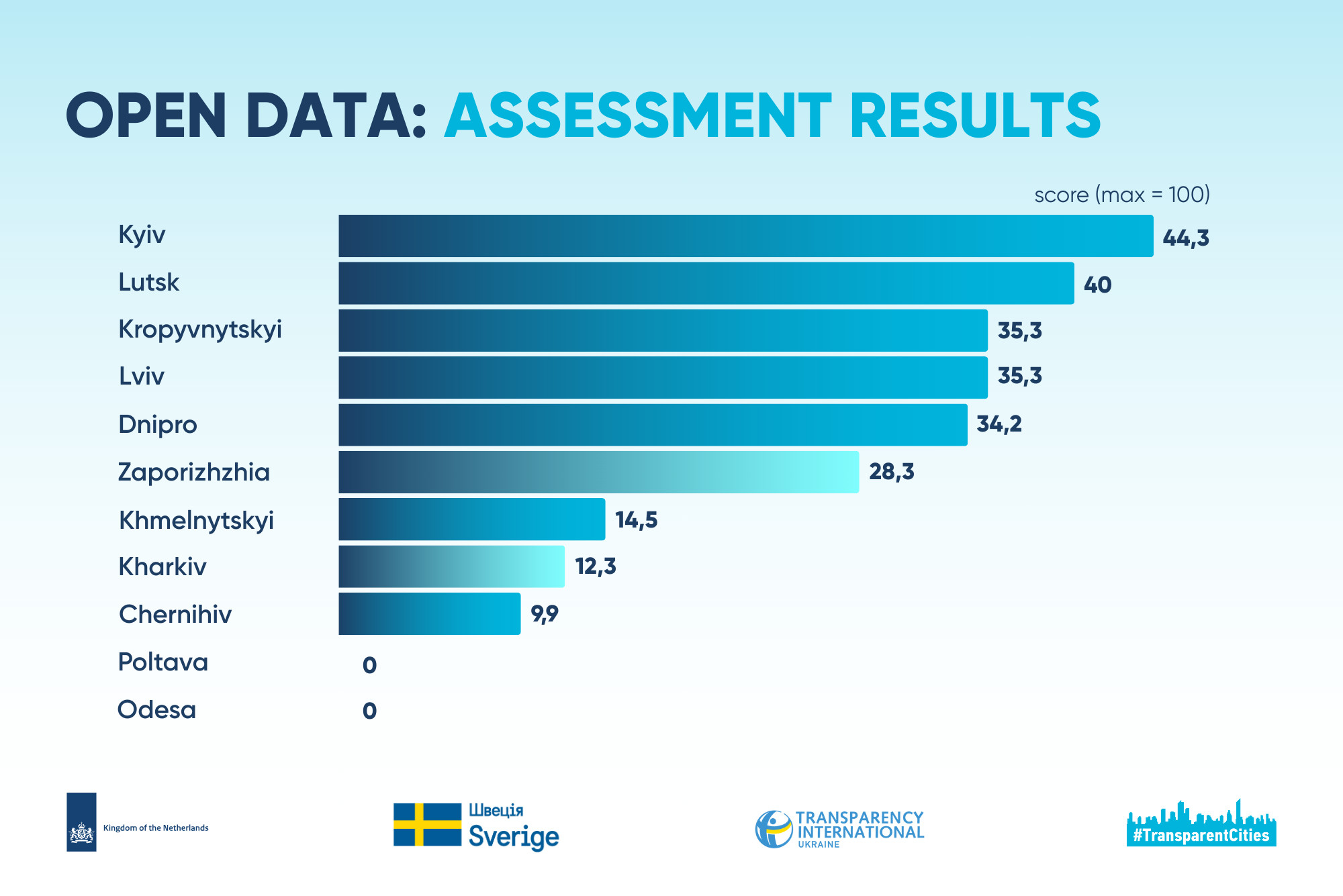
On average, cities implemented all criteria at 23.1%.This result is significantly lower than in previous studies focused on openness and e-services. However, city councils share responsibility for this outcome with the Ministry of Digital Transformation, since the scores were also affected by technical infrastructure issues on the Unified Open Data Portal.
Kyiv ranked first with 44.3 out of 100 points. Next came Lutsk (40), then Kropyvnytskyi and Lviv (35.3 each). The lowest results were recorded by Odesa (0), Poltava (0), and Chernihiv (9.9).
“Kyiv owes its leadership to two factors. First, in 2024, the city authorities approved a key administrative document that incorporated the Ministry’s updated recommendations and began systematically populating the Kyiv City State Administration account on data.gov.ua based on those recommendations. Second, unlike Lutsk, Kropyvnytskyi, Lviv, and Dnipro, Kyiv now publishes its datasets exclusively on the Unified State Open Data Web Portal, so it does not face delays in transferring data from a local portal to data.gov.ua, which affected other cities’ scores,” notes Yuliia Sysoieva, Senior Analyst at the Transparent Cities program.
The assessment results revealed a significant gap between Ukraine’s high rankings in international and national open data ratings and the real implementation in major cities. In the Digital Transformation Index of Territorial Communities, some cities report nearly 100% publication of mandatory datasets, while Open Data Maturity 2025, which assesses countries’ institutional maturity in open data across Europe (policy, quality, reuse, and impact), places Ukraine in a high position.
In reality, however, of the 270 “EU integration” datasets that were expected to be available in city accounts on data.gov.ua, cities had published 148 (55%). Only 51 datasets had resources updated on time, and only 6 datasets fully complied with all key requirements of the Ministry of Digital Transformation (4 from Kyiv, 1 from Dnipro, and 1 from Lviv). One reason for this outcome is that Dnipro, Kropyvnytskyi, Lutsk, and Lviv city councils—leaders by number of published datasets—use their own open data portals, while regular monthly transfer of data from those portals to data.gov.ua is currently not taking place.
Among the problems that, according to analysts, are preventing the open data sphere from developing properly are:
- uncoordinated state policy at the national level;
- outdated architecture of the data.gov.ua portal, resulting, among other issues, in data upload problems and irregular transfer of data from local portals;
- a fragmented approach by local self-government bodies to data publication, which significantly worsens accessibility;
- untimely data updates;
- low data interoperability (non-unified dataset structures and data resource structures);
- weak linkage between data and services, meaning open data does not fulfill its core function—supporting tools for residents and evidence-based management decisions.
“We understand that low city scores are often linked not only to local government actions, but also to national-level decisions, technical infrastructure, and policies for which, in particular, the Ministry of Digital Transformation of Ukraine is responsible. So, on the one hand, we call on cities to do everything within their authority and capacity to improve the quality and accessibility of their own policies and data. On the other hand, we are working closely with the Ministry to remove systemic barriers and adopt changes at the national level. The Ministry is actively working to improve the situation,” said Olesia Koval, Transparent Cities Program Manager.
For representatives of city councils that were not included in the pilot study, analysts developed a special form to help them independently assess how well a city complies with open data standards and identify weak points that require improvement. Experts are also preparing to scale the methodology and plan to increase the number of cities assessed.
In December 2025 the program presented results from the second block of the European City Index. Experts assessed how well city e-services comply with European standards. Kyiv showed the highest result, with 70 out of 100 possible points. Lviv (63 points) and Kharkiv (58 points) also ranked among the top three.
This research is made possible with the support of the MATRA Programme of the Embassy of the Kingdom of the Netherlands in Ukraine, and with the financial support of Sweden within the framework of the program on institutional development of Transparency International Ukraine. Content reflects the views of the author(s) and does not necessarily correspond with the position of the Embassy of the Kingdom of the Netherlands in Ukraine or the Government of Sweden.
Transparency International Ukraine is an accredited representative of Global Transparency International. Since 2012, TI Ukraine has been helping Ukraine grow stronger. The organization takes a comprehensive approach to the development and implementation of changes for reduction of corruption levels in certain areas.
TI Ukraine launched the Transparent Cities program in 2017. Its goal is to foster constructive and meaningful dialogue between citizens, local authorities, and the government to promote high-quality municipal governance, urban development, and effective reconstruction. In 2017–2022, the program annually compiled the Transparency Ranking of the 100 largest cities in Ukraine. After the full-scale invasion, the program conducted two adapted assessments on the state of municipal transparency during wartime. In 2024, the program compiled the Transparency Ranking of 100 Cities, and in 2025, it launched an updated format for assessing city councils — the European City Index.