The Transparent Cities program has once again checked how participatory budgeting works in Ukrainian cities under martial law. In 2025, only seven of the 50 largest cities held a competition.
Participatory budgeting is a local democracy tool that, for the past decade, has allowed community residents to propose their own projects, take part in decision-making by local self-government bodies, and influence how local budget funds are allocated.
In 2021, 40 out of the 50 largest cities earmarked funds to implement public budgeting. After the start of the full-scale invasion, however—particularly in 2023–2024—only six cities from the same sample maintained an opportunity for residents to influence the allocation of local budget funds. While examining the issue now, analysts also checked whether city councils provide convenient access to participatory budgeting information. For example, through a dedicated page with up-to-date, substantive content, a separate platform for implementation, and all necessary links for easy navigation (the “single entry point” principle).
Which cities implemented participatory budgeting in 2025?
In 2025, 43 of the 50 cities reviewed did not run participatory budgeting. At the same time, seven cities are currently actively finalizing results: one city has announced winners with implementation planned for 2026 (Uman), while six cities have already implemented, or are currently implementing, the winning projects. During martial law, Ivano-Frankivsk, Kamianske, Lutsk, and Khmelnytskyi ran competitions again. Meanwhile, Mykolaiv and Sheptytskyi introduced participatory budgeting in the form of a youth participatory budget, adapting the competition after a break since 2022.
Vinnytsia did not hold a competition this year, although in 2023 the city accepted projects for implementation in 2024. Other cities that introduced the competition in 2023–2024 have maintained this practice this year as well.
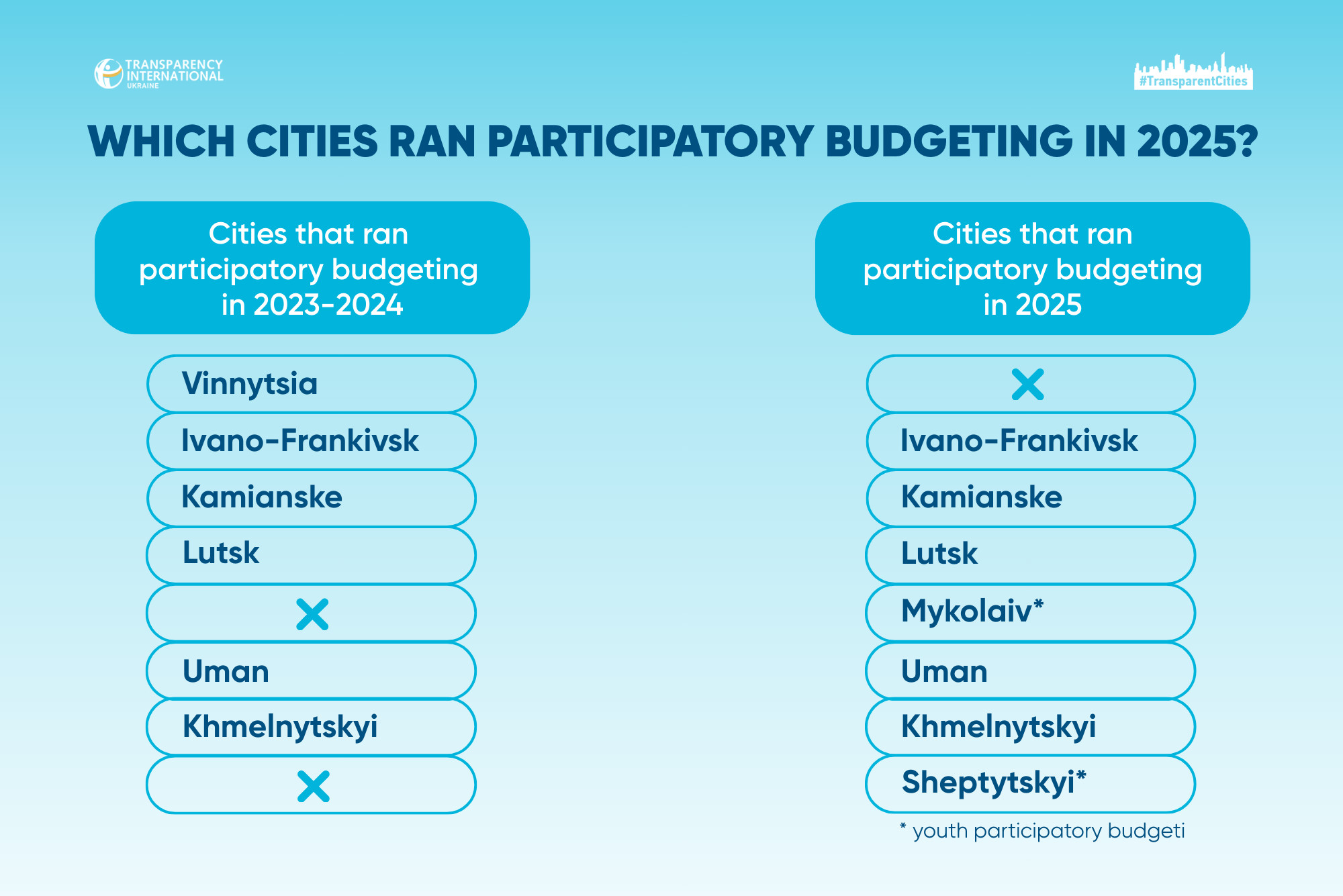
Most cities that ran participatory budgeting are concentrated in Ukraine’s western regions (four cities). Another two are in the central part of the country, while the southern region is represented only by Mykolaiv.
This year, the submitted projects covered a wide range of thematic areas. As in the previous year, a significant share of initiatives focused on support for the Armed Forces of Ukraine, veterans, and internally displaced persons. Compared to earlier years, there was also a noticeable increase in interest in developing public spaces and in the sports and culture sectors in cities. Even within these categories, residents often combined development-oriented projects with a social component aimed at supporting military and veteran communities. Such initiatives included purchasing equipment for the needs of the military (for example, in Ivano-Frankivsk), setting up veteran development centers (in Khmelnytskyi), health and recovery programs (in Lutsk), and improving sports grounds (for instance, in Uman). Residents also paid particular attention to safety and accessibility issues, including repairing shelters and creating inclusive spaces for people with disabilities (for example, in Lutsk).
The (in)accessibility of information about the competition
All the cities reviewed use digital services to implement participatory budgeting. Although most municipalities did not hold a competition in 2025, they generally maintain a single page dedicated to participatory budgeting or provide a link to the relevant platforms. This not only helps preserve the history of implemented projects, but also serves as a ready-made base for launching new initiatives and keeping residents informed about the current status of the competition. Such a section or an official website link was created by 36 of the 50 cities assessed.
A common approach is to use dedicated participatory budgeting platforms: 43 cities are registered on services such as E-dem or have a separate page under the pb.org.ua domain. Some cities have developed their own similar e-service to deliver participatory budgeting (for example, Odesa). Twenty-six municipalities have a single participatory budgeting page on the city council’s official website, along with a link to the platform where project competitions were previously held or continue to be held. Examples of this approach include Vinnytsia, Drohobych, Okhtyrka, Uzhhorod, Shostka, and others. None of these cities implemented participatory budgeting this year.
Most cities are trying to introduce positive practices; however, analysts identified certain inconsistencies during the review. For example, Zaporizhzhia’s city council website has two pages dedicated to participatory budgeting. One of them provides information about the E-dem platform, yet the local authority is not registered on that platform. Berdychiv has a hyperlink in its website menu leading to a “participatory budget” page, but it currently does not work either.
At the same time, the situation is less positive when it comes to the content of participatory budgeting pages. Most city councils that did not run a competition this year provided no public explanation for that decision. Only five municipalities published comments, and these were largely formal in nature. Lviv can be cited as a strong example of communicating the council’s position.
In two cities, it was not possible to find any information about the use of this tool—either in the form of a platform or a dedicated page on the city council website: Izmail and Oleksandriia.
Overall, there is a systemic problem: the content of participatory budgeting pages or platforms often does not allow residents to understand the current status of the tool. City councils do not provide clear information on whether a competition is being held in the current year, whether implementation has been suspended, and what reasons led to that decision. As a result, citizens may be able to access a page as such, but they do not receive a complete, clear answer about opportunities to participate or the prospects for resuming participatory budgeting.
Conclusions and recommendations
Only a small share of cities ran participatory budgeting in 2025. Despite local self-government bodies’ efforts to optimize budget spending amid a prolonged war, the experience of those cities that held competitions this year shows that residents are primarily interested in supporting the military and helping people affected by the hostilities. The Transparent Cities program stresses the importance of this tool and hopes that city councils will bring participatory budgeting back, or optimize it, so that residents can demonstrate their own vision of the community’s needs.
The program’s analysts have prepared a set of recommendations for cities depending on the current state of participatory budgeting implementation:
- The program emphasizes the importance of preserving and running participatory budgeting in cities. Even with limited resources, participatory budgeting can be adapted to less costly formats while retaining its core function: giving residents a real opportunity to influence how local budget funds are allocated.
- If a city council is unable to implement participatory budgeting under martial law, it is important to proactively inform residents of this decision and clearly state the reasons, the timeframe of restrictions, and possible alternative formats for participation. This should be done as a notice or an official document on the page dedicated to participatory budgeting, ensuring a systematic and coherent approach.
If participatory budgeting is being run, we recommend:
- Create and regularly update a single section/page on the city council’s official website dedicated to participatory budgeting in the city. This page should be visible in the website’s main menu (for example, under “Budget,” “For the public,” etc.) and include: information on the competition’s status for the current year; information on any planned optimization or changes to the format; the city council’s position in cases where participatory budgeting is not implemented under martial law; an active link to the competition platform (if available); and relevant regulatory acts and other documentation related to participatory budgeting.
- Create or join participatory budgeting competition platforms, if this has not yet been done. The most common options are E-dem and pages under the pb.org.ua domain. Another option is to create a similar in-house service or run competitions through a “single entry point” on the city council’s official website (see the previous recommendation). Such a page should enable project submission, selection of project themes, and voting; provide information on the status of the competition and the winners; and include an archive and ranking of projects (or filtering by key project characteristics). The local self-government body should provide a link to the platform from the participatory budgeting section on the council’s official website.
Participatory budgeting is not only a tool for allocating funds, but also an important mechanism for interaction between local authorities and citizens—one that helps sustain trust, engagement, and a sense of shared responsibility for community development. Even under martial law, it creates space for dialogue, gives residents a chance to articulate priorities, and allows them to propose solutions that respond to real community needs. The practice of cities that have preserved or adapted participatory budgeting demonstrates that civic participation does not disappear during crises; rather, it transforms, focusing on security, social cohesion, and support for those affected. That is why systematic and transparent engagement with citizens should remain a governance standard, not an optional add-on for local authorities.