On September 30, Transparency International Ukraine's Transparent Cities program presented the results of the pilot European City Index. None of the 11 cities studied achieved a consistently high result: the top score, 55.3 out of 100, went to Kyiv. Analysts assessed 10 regional centers and Kyiv in six areas — openness, e-services, open data, public finance, integrity and anti-corruption, and accountability — and concluded that Ukrainian cities have strong individual practices but lack a systematic approach.
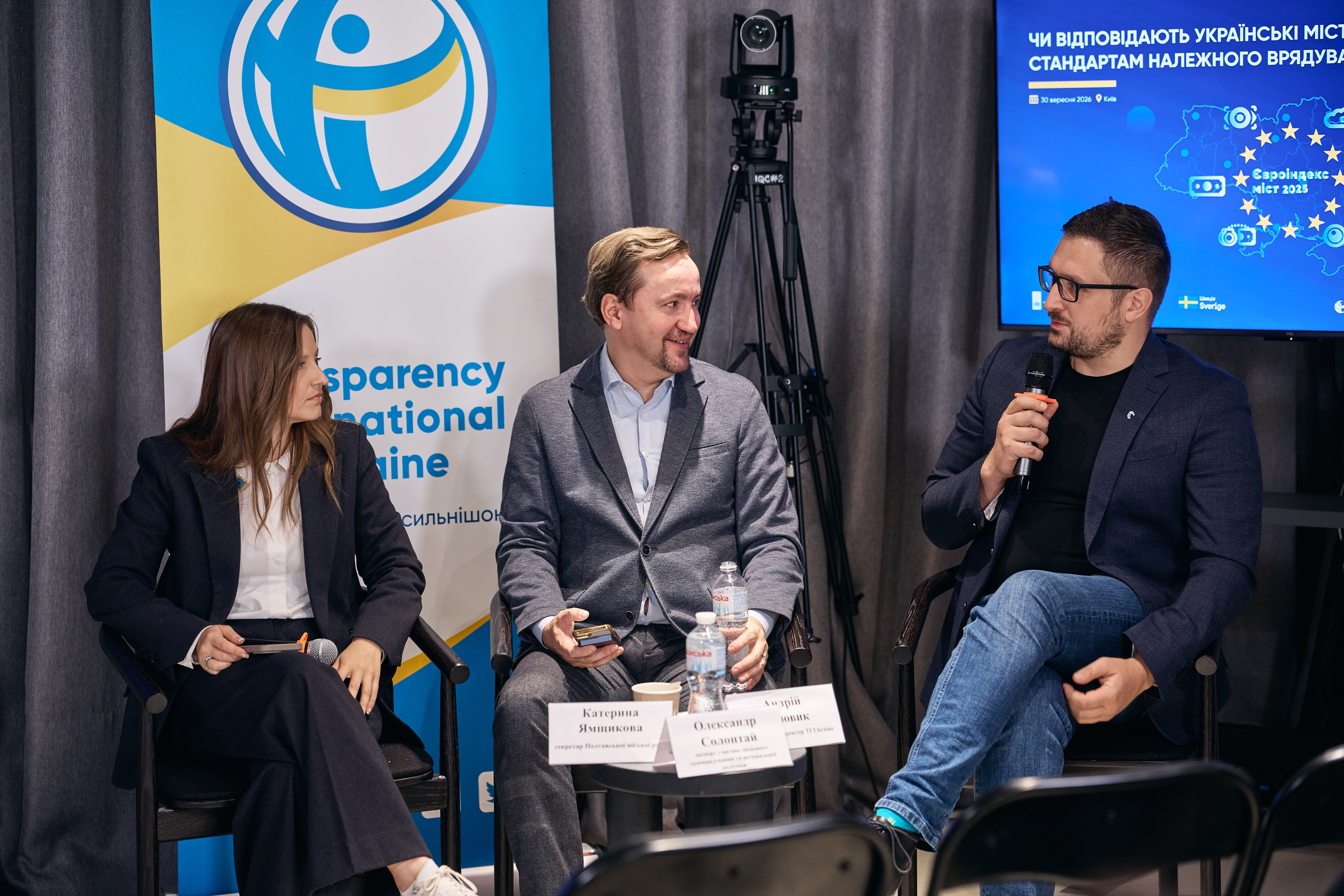
During the discussion, participants talked about what Ukrainian cities still lack to move closer to European standards and which local self-government practices can already be useful to municipalities today.
Andrii Borovyk, Executive Director of Transparency International Ukraine, explained that European integration cannot remain solely a matter of state-level negotiations. It has to become a national movement that involves everyone — from communities and citizens to the government and public servants.
“European integration should not remain merely an expert discussion about benchmarks, negotiating chapters, or conditions. It is important that every level understands what it means in practice. After all, standards adopted at the national level are ultimately implemented locally — where government is closest to the people”
One of the key challenges remains the shift from individual successful solutions to a sustainable model of governance. Presenting the study's findings, Olesia Koval, Transparent Cities Program Manager, pointed to the uneven results and the absence of high overall scores. Even Kyiv fell short of 75 points overall and did not fully demonstrate leadership in this study.
“We did not see a single city that performed equally well in all the areas studied: each has its strengths, but also significant weaknesses. Requirements are often met as a formality, without enough attention to substance, quality, or benefit to residents. And when we tested some of the indicators on 50 cities, we saw the same problems. This points to a lack of a systematic approach to governance.”

Dmytro Zahumennyi, Chief of Staff of the KCSA, spoke about what external assessment means for city councils themselves. According to him, Kyiv's result is the product of five years of work, during which the city government's structural units developed a unified approach to public disclosure. However, the city lacked external feedback that would show whether it was on the right track.
“We have been working on public disclosure for many years… At the same time, we lacked external feedback — an understanding of whether we are on the right track and whether our changes are producing results. Kyiv's first place shows that changes in regulatory approaches, systematic work, and managers' conviction that these changes are needed have paid off… We are ready to keep fighting to complete this path as quickly as possible and with better results,” Zahumennyi added.
Although Kyiv outperformed the other cities, the capital still has many gaps to close. In particular, Olesia Koval recalled that the legal requirement for the mayor to report to the community twice a year is not being met. The KCSA Chief of Staff gave assurances that he is aware of the public demand for a meeting with the mayor and is working to make the reporting happen.
“Both the report and the demands set out in the petition will be taken into account. This is just as much a priority for us. And today's event is further confirmation that it must happen, and must happen this year. We are working on it,” Zahumennyi said.

Poltava is among the cities that made the most progress in the repeat assessments of openness and e-services. Kateryna Yamshchykova, Secretary of the Poltava City Council, called the city's participation in the study an opportunity to see the real state of affairs and identify areas for growth. She also highlighted the Transparent Cities approach of assessing information from an ordinary user's perspective. In her view, people should be able to visit the city council's website, find what they need, and make sense of it without knowing bureaucratic procedures.
“For us, the study's results are not a reason to dispute the score but a starting point for growth. The city receives specific recommendations and an understanding of exactly where processes need to change. In Poltava, we have already set up a dedicated workstream; we are assigning responsible staff, reviewing internal approaches, and constantly tracking progress... It is especially important that the assessment looks at the city through a resident's eyes: information should be easy to find and understand without knowledge of the internal bureaucracy,” Yamshchykova is convinced.
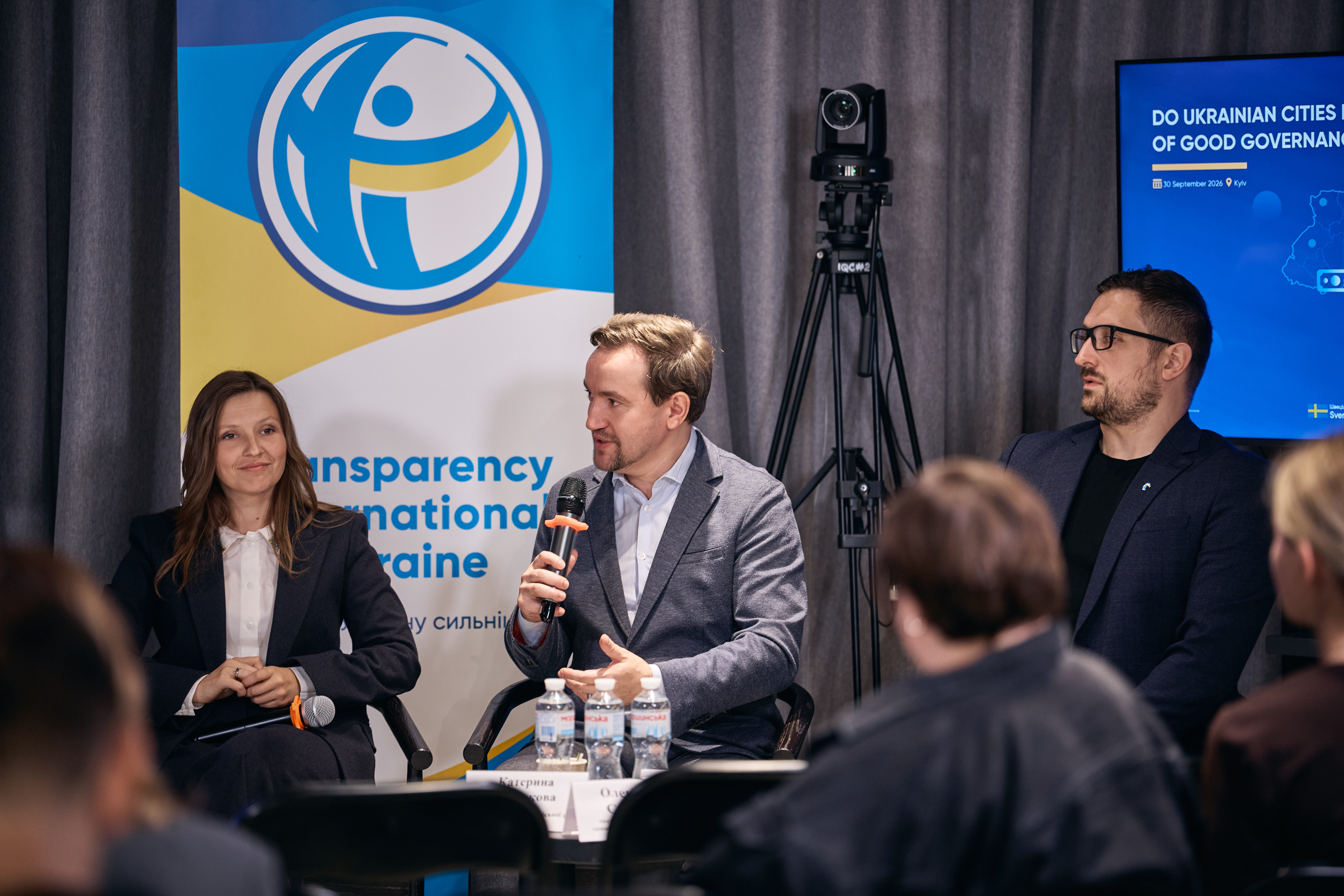 Oleksandr Solontai, an expert on local self-government and regional policy, singled out the development of the study's methodology. He believes, part of the European City Index's value is that it helps translate concepts such as openness, integrity, and European principles of governance into specific indicators and practices.
“I am glad that the Transparency Ranking lives on and continues to develop in a new product. Over the years, it has evolved, improved, and become much deeper methodologically. The methodological deepening you are presenting this year as the European City Index is a truly powerful and important step,”
He stressed that European integration has an entirely practical dimension in every community. Cities can demonstrate compliance with European principles through specific governance decisions.
“We all want to increase the number of funds and institutions our communities and cities work with. That raises the question: what do we need to do to get there? First and foremost, present our community as European, transparent, and open,” Solontai added.
Investigative journalist Pavlo Lisnychenko also stressed the need for a grown-up dialogue and for transparency on the part of city authorities. In his view, officials do not always have to explain every decision or problem personally. Independent media can perform part of this function — provided the authorities give them access to information and do not obstruct their work.
“To avoid having to communicate every problem separately — say, every pothole — sometimes it is enough simply to let journalists do their job well. Because if the authorities do not explain what is happening themselves, the information vacuum will be filled anyway. Journalists and the media should not be seen as opponents or a hostile party. On the contrary, in most cases they are ready not only to talk about problems but also to highlight positive results. The main thing is that these results are backed by facts,” Lisnychenko said.
 That said, government openness is not limited to communication with the media. It requires systematic work with residents: clear strategies, consistent implementation of decisions, and regular reporting on results. This was emphasized by Andrii Borovyk, Executive Director of Transparency International Ukraine. He also noted that Ukrainian cities already have considerable experience of working in crisis conditions, which they can share with European municipalities.
“In some places cities lack a systematic approach, in others a strategic vision, but there are also practices we can definitely teach European cities. That is why this project is really also about our own internal institutional capacity, which we — our team, experts, and local self-government — can build together in Ukraine,”
The participants concluded that cities need to strengthen systematic openness, transparency, and their focus on people's needs. High-quality communication with residents and the media is no less important.
This also benefits city councils themselves: when information is easy to find and understand, decisions are properly explained, and journalists have access to data, there is less need for additional requests and clarifications. Such openness also helps build trust among residents and partners, both in Ukraine and abroad.
The European City Index will continue to scale up. The program plans to move to assessing 50 Ukrainian cities in seven areas and to continue consultations with municipalities. Cities that did not take part in the pilot study can already use the self-assessment forms developed by the program to check their own practices and identify areas for improvement.
This research was prepared with the support of the MATRA Programme of the Embassy of the Kingdom of the Netherlands in Ukraine and with financial support from Sweden within the framework of the Transparency International Ukraine institutional development program.
The content of this publication is the sole responsibility of the authors and does not necessarily reflect the official position of the Embassy of the Kingdom of the Netherlands in Ukraine or the Government of Sweden.