Amid the war, business relocation, and constant security threats, filling local budgets remains a challenge for Ukrainian cities. Communities' main financial resource is the personal income tax (PIT); yet, as the study notes, the larger the share of own revenue a community raises from local taxes and fees within its total income, the more resilient it is in a crisis. The analysts of the Transparent Cities program looked at how much 50 Ukrainian cities managed to raise from local taxes and fees in 2025.
The personal income tax (PIT) makes up the lion's share of local self-government's fiscal capacity — 64% of this tax now stays in local budgets. The more officially employed workers a community has, the higher its revenue. An added incentive to attract business to communities is that 10% of the corporate income tax is also credited to city budgets. Local taxes and fees, for their part, are likewise an important source of city revenue.
Under the Tax Code of Ukraine, local taxes comprise the property tax and the single tax, while the fees comprise the tourist tax and the fee for vehicle parking spaces. Their rates are set by local self-government bodies themselves. Although city councils do not administer taxes directly, all of this revenue depends on how well a city creates the conditions for its tax base to grow — attracting investment, supporting local business, taking inventory of land and real estate — and on making sound decisions about rates and reliefs.
According to the State Web Portal of the Budget for Citizens (Open Budget), in 2025 Ukraine's 50 largest cities together raised more than UAH 76 billion from local taxes and fees. As of early July 2026, these municipalities had already brought in more than UAH 36.5 billion in own revenue.
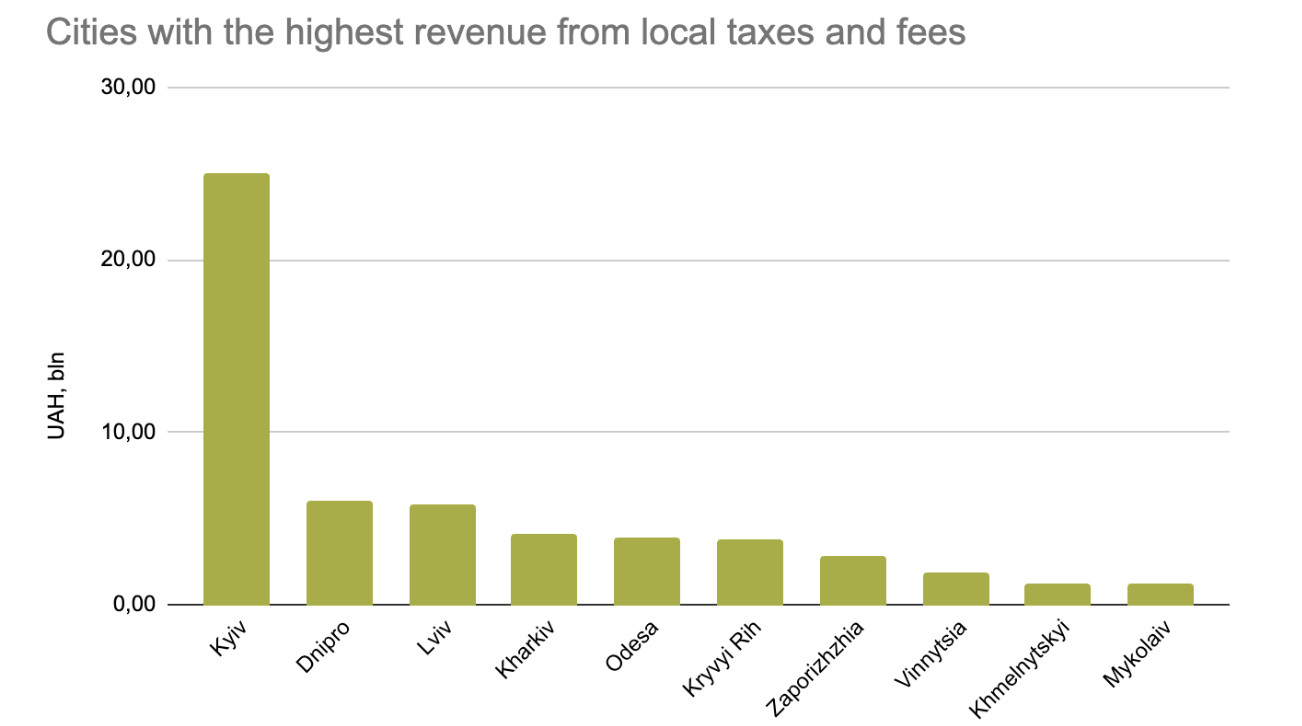
In 2025, own revenue exceeded UAH 1 billion in 15 cities: mostly regional centers, but also two cities in Dnipropetrovsk Region — Kryvyi Rih and Kamianske. On average last year, local taxes and fees accounted for 21.2% of the revenue of the local budgets analyzed.
In absolute terms, Kyiv raised the most — over UAH 25 billion, almost a third of the total across the entire sample of 50 cities. The second- and third-largest figures belong to Dnipro (UAH 6 billion) and Lviv (UAH 5.8 billion). The top five by revenue also included Kharkiv (UAH 4.2 billion) and Odesa (UAH 3.9 billion). These are the most populous cities in the sample, so it is only natural that their billion-hryvnia totals mainly reflect their size and the corresponding concentration of taxpayers. More telling is the share of local taxes in a budget's total revenue.
The highest share of local taxes and fees in revenue for 2025 was recorded in Kryvyi Rih, at 33.1%. No other city in the sample crossed the 30% mark, though Kamianske, Irpin, Horishni Plavni, Lviv, and Izmail came close. Tellingly, the top performers are communities of different sizes — industrial cities, a regional center, and a mid-sized town near the capital, Irpin. In all, exactly 25 of the 50 cities came in above the 21.2% average, and just as many fell short of it. 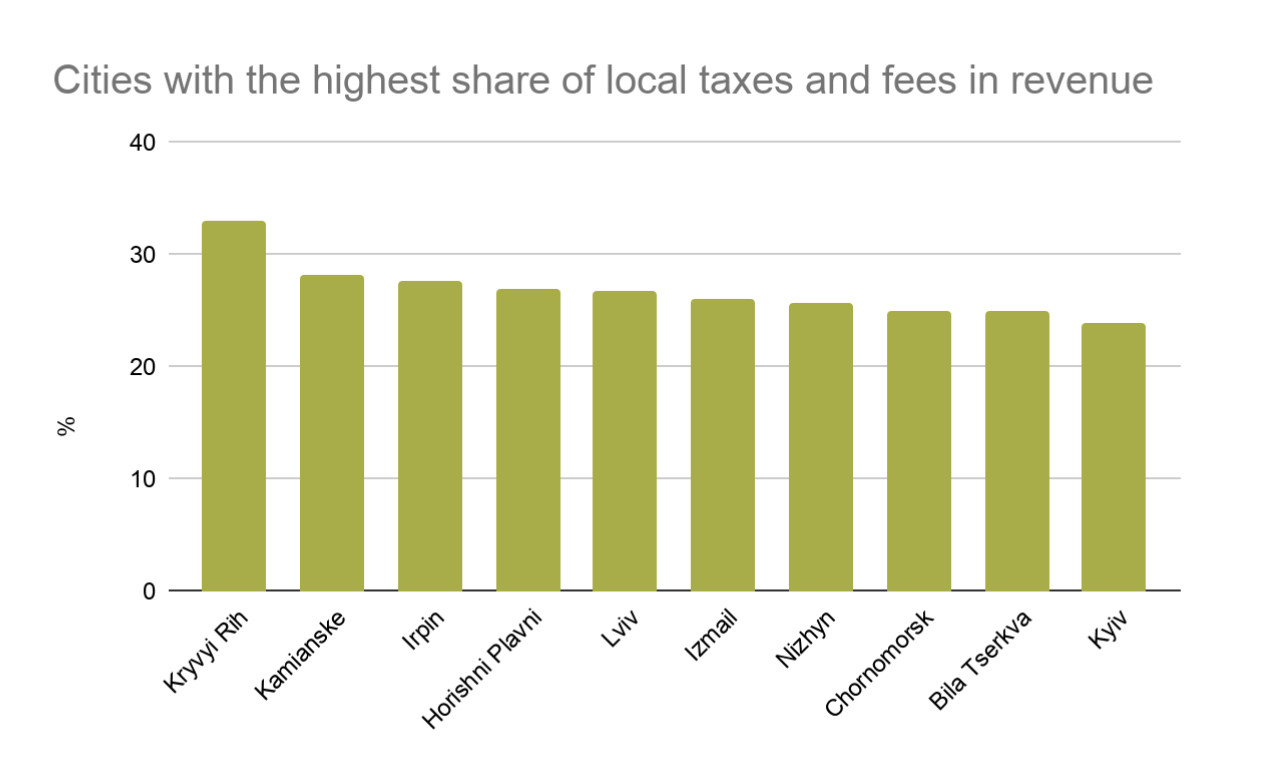
At the other end are the cities where local taxes make up the smallest share of revenue — among them communities in Sumy Region: Shostka (10.4%), Okhtyrka (12.6%), Sumy (14.6%), and Konotop (15.1%). Missile and drone strikes, the relocation of businesses and single-tax payers, and a decline in entrepreneurial activity all bear directly on local revenue. A comparatively low share of revenue from local taxes and fees was also recorded in cities far from the front — Kolomyia in Ivano-Frankivsk Region (15.2%) and Lutsk in Volyn Region (17.8%).
It is also worth noting that, for the duration of martial law, local self-government bodies may grant tax reliefs without following the procedures set out in the Law on the Principles of State Regulatory Policy in the Sphere of Economic Activity. Kharkiv is an example of a council deliberately easing the tax burden: since 2024, the city has offered businesses reliefs and exemptions from local taxes. Even so, entrepreneurs keep operating and paying taxes — single-tax revenue in the city came to UAH 3.8 billion, or over 90% of all local taxes and fees collected in 2025. This allows Kharkiv to maintain strong overall revenue figures even amid unprecedented challenges.
All told, UAH 76 billion across 50 cities is a substantial resource that communities managed to raise through local taxes and fees. What is more, according to the State Tax Service, tax revenue is growing, and the figures for the first half of 2026 are running ahead of last year's. Yet the 21.2% average is a reminder that most municipal revenue is still generated by nationwide taxes (primarily the PIT) and transfers from the state budget. From the standpoint of European integration standards, financial decentralization assumes that communities should gradually become more self-sufficient. High financial autonomy is, of course, something to aim for in peacetime, yet the push to strengthen a community's own capacity matters now as well. The indicators of the Ukraine Plan under the Ukraine Facility bear this out: the public finance management component spells out fiscal decentralization as the path to more capable local self-government.
We are confident that Ukrainian cities understand their financial potential, audit the resources they have, and take inventory of their property. To strengthen their resilience, then, local self-government bodies would do well to shift their focus to more comprehensive management tools. An essential element here is ensuring openness and dialogue with businesses. Entrepreneurs and other residents should be brought into decisions on the rates and reliefs for local taxes and fees, and the most current information should be published in a user-friendly way — in a dedicated section on the local budget, specifically on a page about local taxes and fees. Businesses are willing to pay taxes where they see transparent rules of the game and understand where their money goes.